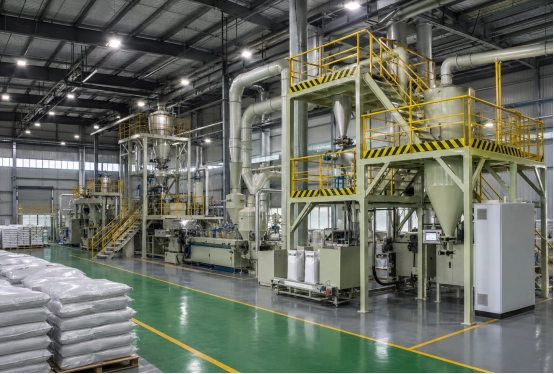
A liquid paint factory already has valuable production experience. Operators understand formulation control, batch records and color matching. Moving into powder coating still requires a serious process redesign.
The difference is not only the absence of solvent. Powder coating is produced as a dry solid through premixing, melt extrusion, cooling, pulverizing and particle classification. The factory must handle heat and powder dust instead of liquid dispersion and solvent or water management.
Liquid Paint vs. Powder Coating Manufacturing at a Glance
The core production differences are clear:
| Manufacturing aspect | Liquid paint | Powder coating |
| Main carrier | Water or organic solvent | No liquid carrier; 100% solid formulation |
| Initial mixing | Liquid blending and dispersion | Dry premixing of resin, pigments and additives |
| Core processing | High-speed mixing, milling and let-down | Melt extrusion followed by cooling and pulverization |
| Product form | Liquid in cans, drums or totes | Dry powder in bags or bulk containers |
| Main production risks | VOC handling, solvent compatibility, settling | Dust control, particle-size variation, cross-contamination |
| Final cure | Depends on the customer’s application process | Usually heat-cured after application |
The final curing step also occurs later. A powder coating production line makes the powder. The customer normally applies it and cures it in an oven.
Raw Materials and Formulation: What Changes First?
The formulation room is often where the transition becomes real.
A liquid paint formula may include resin, pigment, additives and a large proportion of water or solvent. The carrier keeps the mixture pumpable and allows the coating to be applied in liquid form.
A powder formula is built from solid components. These usually include resin, curing agent, pigments, fillers and functional additives. Each material affects the extrusion behavior as well as the final coating.
Powder manufacturers must define more than color and gloss. Cure temperature matters. So do gel time, weather resistance, flow and particle size. A formulation that looks correct in the laboratory can still fail if it grinds poorly or becomes unstable during storage.
The Powder Coating Production Process Step by Step
The powder process is a connected sequence. Each stage affects the next one. Poor premixing can create extrusion variation. Poor cooling can make grinding unstable. Incorrect classification can change application performance.
1. Raw Material Receiving and Storage
Resin, pigments, fillers and additives are received by batch. Incoming inspection should confirm identity and basic quality before materials enter production.
Storage conditions deserve attention. Moisture can affect powder flow and storage stability. Different colors or resin systems also need clear separation to reduce cross-contamination.
2. Dry Premixing
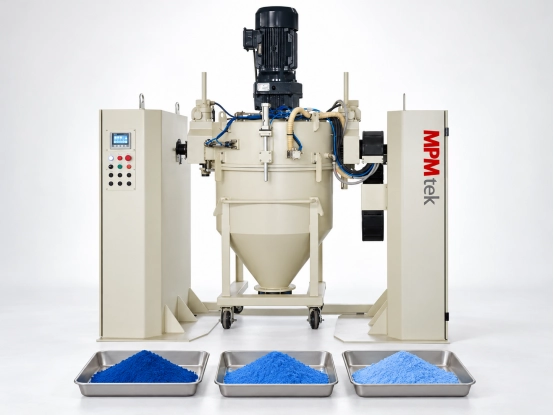
The formulation is weighed and loaded into a dry premixer. The goal is a consistent distribution of solid materials before they enter the extruder.
This stage is more important than it may appear. If pigment or curing agent is not distributed evenly, the extruder cannot correct the entire problem. The result may be color variation, uneven curing or inconsistent mechanical performance.
3. Melt Extrusion
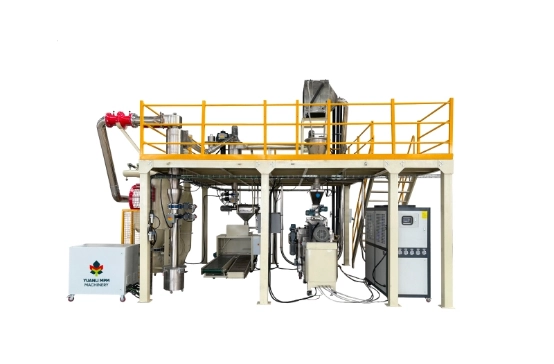
The premixed material enters a heated extruder. Controlled heat and shear melt the resin and distribute the pigments, fillers and additives through the compound.
This is the main difference from liquid paint dispersion. The ingredients are homogenized in a molten state rather than suspended in a liquid carrier.
Extruder temperature, screw speed and residence time must match the powder chemistry. Excessive heat can damage the formulation. Insufficient mixing can leave unmelted material or create weak dispersion.
For manufacturers comparing line options, the powder coating extruder is usually one of the most important equipment decisions.
4. Cooling and Flake Formation
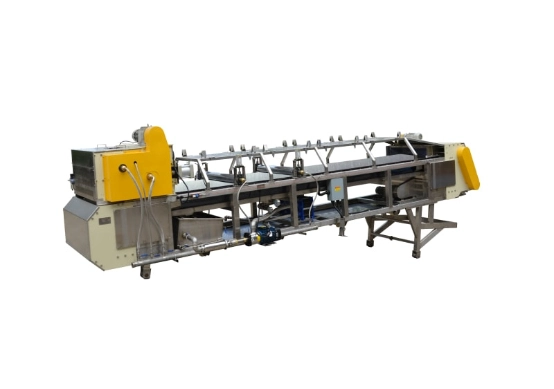
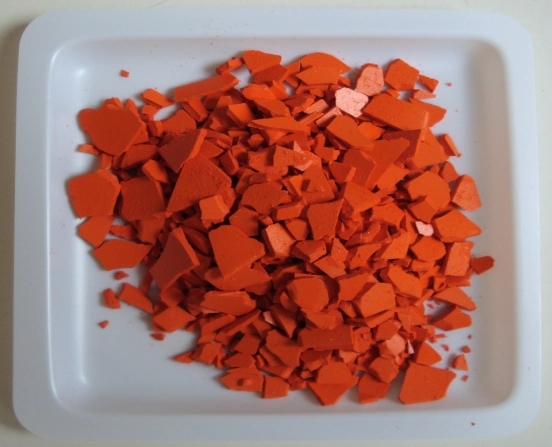
The hot extrudate leaves the machine and passes through a cooling system. It is converted into a sheet, chip or flake that can be ground efficiently.
Cooling must be consistent. Material that remains too soft may overload the grinder. Material that cools unevenly can produce unstable particle sizes and unnecessary fines.
A cooling conveyor is not just a transfer device. It helps determine how reliably the next stage operates.
5. Pulverizing and Particle Classification
The cooled flakes are reduced to powder in a pulverizing system. A classifier separates particles according to the required size range.
Particle size affects spraying behavior, film thickness, transfer efficiency and surface appearance. Oversized particles may be returned for further processing when the line design supports recycling.
The powder coating mill and classifier must be selected around the target products. A line for one resin system may not perform the same way with another.
6. Sieving, Final Blending and Packaging
The finished powder is sieved to remove unwanted particles. Some products then receive final blending before packaging.
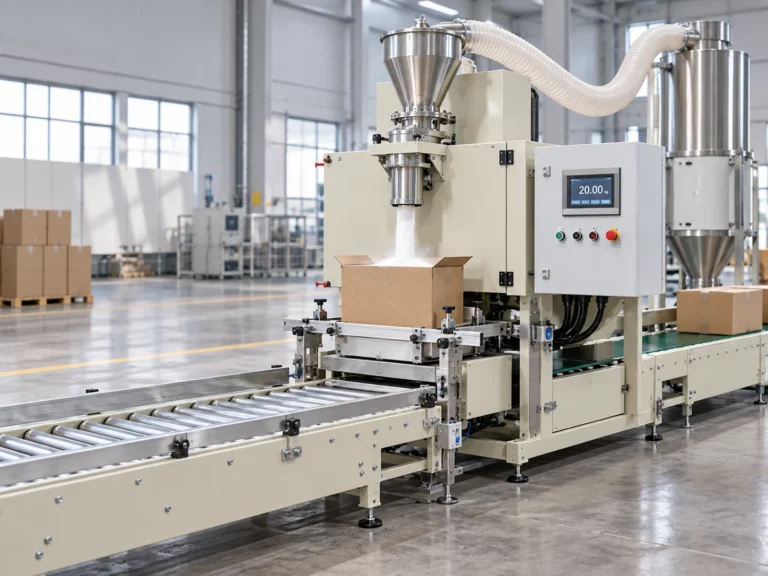
Packaging protects the powder from moisture and contamination. It also needs accurate weighing and batch labeling. When a plant produces many colors, cleaning and changeover procedures can have a direct effect on production capacity.
Equipment Changes When Converting a Liquid Paint Factory
Some parts of a liquid paint plant may remain useful. The laboratory, warehouse structure and quality-control routines can often be adapted.
| Existing liquid-paint function | Powder-coating replacement or addition |
| Mixing tanks and agitators | Dry premixer or high-efficiency pre-blending system |
| Bead mill or dispersion mill | Melt extruder |
| Liquid filtration | Pulverizer, classifier and sieving system |
| Solvent or water handling | Thermal control, cooling and dust-collection systems |
| Liquid filling machine | Powder packaging and weighing system |
| Liquid transfer pumps | Screw conveyors, pneumatic conveying or other powder-transfer equipment |
A powder coating production line should be designed as an integrated system. Dosing, extrusion, cooling, grinding and packaging cannot be sized independently without creating bottlenecks.
Plant Layout, Utilities and EHS Requirements
Powder production works best with a clear one-way material flow. Raw materials should move from storage to weighing, premixing, extrusion, cooling, grinding and packaging without unnecessary backtracking.
The site review should cover electrical capacity, cooling water, compressed air, ventilation and dust collection. Floor space is only one part of the layout problem. Access for maintenance matters just as much.
Powder dust creates housekeeping and combustible-dust concerns. Grounding, sealed transfer points, suitable filtration and regular cleaning need to be included in the design. Powder coating reduces liquid VOC handling. It does not remove the need for disciplined EHS management.
Quality Control: Different Tests, Same Need for Consistency
Liquid paint laboratories often focus on viscosity, density, fineness of grind, color and storage stability.
Powder coating laboratories need a different test set. Particle-size distribution matters. So do gel time, flow, leveling, gloss, cure response, adhesion and impact resistance.
Production settings should connect directly to these results. Extrusion temperature can affect cure behavior. Grinding conditions can shift particle size. Sieve configuration can change the percentage of usable powder.
A practical plant keeps retained samples and records process settings for each batch. When a customer reports a coating defect, traceability can save days of investigation.
A Practical Roadmap for Converting from Liquid Paint to Powder
A conversion project should begin with a factory audit. Review the available building area, utilities, workforce and target capacity.
- Audit the current factory, building, utilities, workforce and available floor area.
- Define the target powder products, resin systems, colors, particle-size range and annual capacity.
- Run laboratory or pilot trials to confirm formulation and processing behavior.
- Select line capacity and equipment configuration based on actual throughput, not only nameplate ratings.
- Design dust collection, material handling, cooling and packaging into the same project.
- Install and commission the line in phases where practical.
- Train operators in dry-material handling, cleaning, color changeover, troubleshooting and preventive maintenance.
- Model capital cost, operating cost, labor, energy, waste and expected payback for the specific site.
Generic ROI claims are rarely useful.
Why Work with MPMtek on a Powder Coating Production Line?
A conversion requires more than buying individual machines. The line must connect formulation goals with throughput, layout, automation and serviceability.
MPMtek focuses on powder coating equipment and complete production-line solutions. That makes a process discussion more useful than a machine-only discussion. The right questions concern product chemistry, annual output, available space and future expansion.
Manufacturers planning a turnkey powder coating project can contact MPMtek with their target capacity and site conditions. A preliminary review can then focus on a realistic line configuration.
FAQ
Q: Can existing liquid paint equipment be reused for powder coating?
Some laboratory, storage and administrative resources may be reused. The core process normally requires dry premixing, extrusion, cooling, pulverizing, classification and powder packaging equipment.
Q: Does powder coating manufacturing use solvents?
The finished powder is a dry solid and does not use a liquid carrier. The downstream application and curing process still require separate evaluation.
Q: What information is needed for a production-line quotation?
Prepare the target capacity, powder chemistry, product range, color-change frequency, particle-size requirements, factory dimensions and available utilities.