A powder explosion rarely announces itself. A batch is being milled, fine dust fills an enclosure, one spark is enough — and seconds later the pressure is past anything a normal frame carries. Plants that survive are usually the ones designed for the worst case. So a line specification now includes the dust explosion protection requirements for powder coating equipment — and their cost.
Why Is Dust Explosion Protection Important in Powder Coating Production?
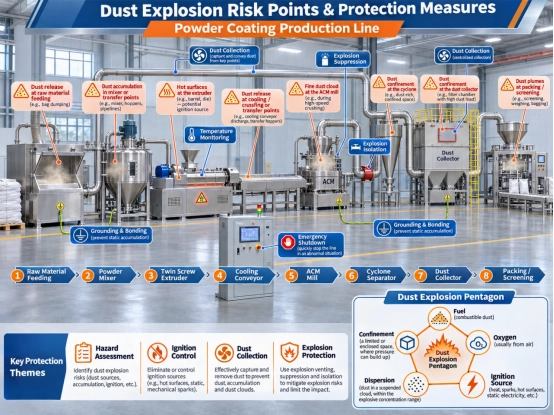
A dust explosion needs five things in one place — fuel, oxygen, an ignition source, dispersion, confinement — and powder coating plants supply most of them. Fine resin and pigment dust stays suspended long after a bag is dumped, while cyclones, ducts and hoppers do the confining. Then a small first event lifts settled dust off floors, ducts and beams — a much larger secondary blast follows. Formulations are not identical, either. One line may run a low-hazard powder in the morning and a far more sensitive one in the afternoon. Powder coating production safety comes down to what each powder actually does when tested.
Where Do Dust Explosion Risks Occur in Powder Coating Equipment?
Raw Material Mixing and Feeding
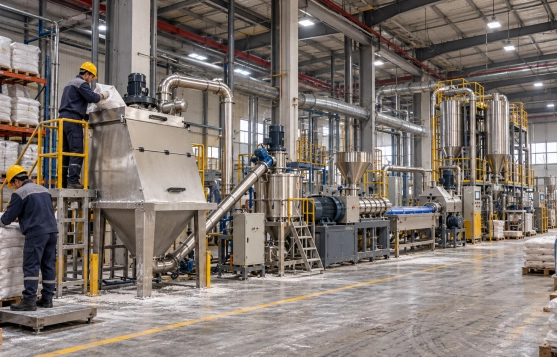
The day starts with the highest dust release rates: bags opened at a dumper, powders weighed, mixers charged. Open transfer points shed dust into operator space, which a sealed самосвал сырья with extraction at the charge point avoids.
Grinding and Milling Systems
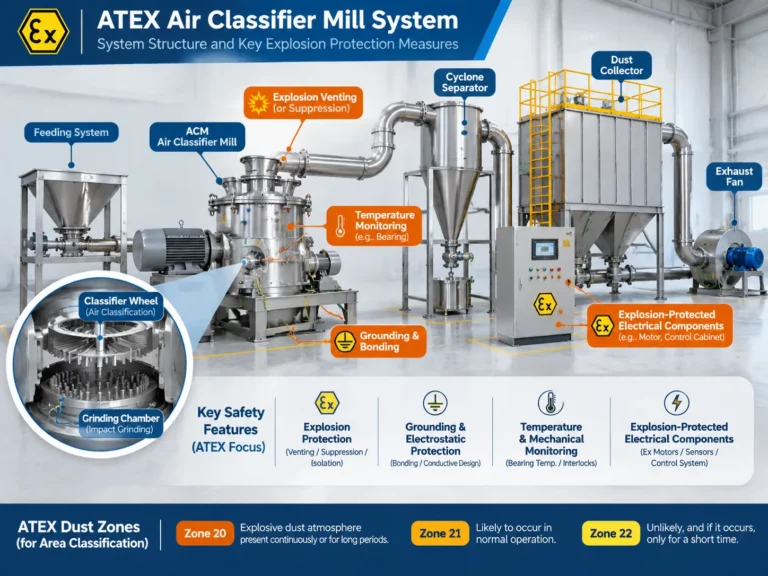
High-speed air classifying mills grind by impact, and the product is a very fine particle cloud. The мельница ACM chain — classifier, cyclone, sieve, collector, fan — concentrates the fraction that disperses most easily. The dust that settles in the housing, on cyclone walls or in duct runs? That is fuel — a spark away.
Conveying, Screening, and Packaging
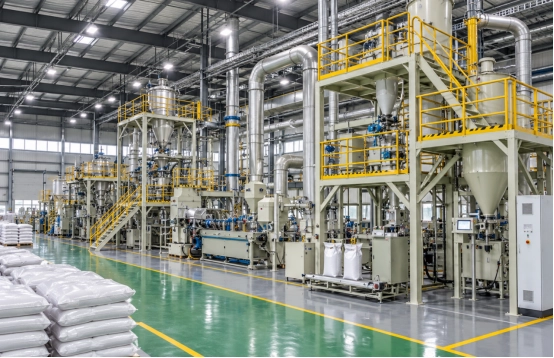
Finished powder moves through conveyors, sieves and автоматическое весовое и упаковочное оборудование — much of it at open or semi-open points. Fill a bag and it throws up its own plume. The sieve deck sheds fines with every pulse. Keep the area clean and extraction running; dust on frames and beams is a safety issue, not housekeeping.
Key Dust Explosion Protection Requirements for Powder Coating Equipment
Five stand out, and the order matters.
1. Conduct a Dust Hazard Assessment
Start from the actual powder, not the machine brochure. Kst, Pmax, minimum ignition energy, explosible concentration, ignition temperature — all vary with formulation, batch to batch. That analysis should walk the whole process; its numbers are what the protection choices lean on.
2. Install Effective Dust Collection and Ventilation Systems
Enclose the transfer points, pull local exhaust where dust is generated, and wire the collector into the process — not onto it. Then clean on a schedule: removing accumulation from ducts, hoppers and overhead surfaces turns a secondary-explosion scenario into a routine.
3. Control Potential Ignition Sources
Electrical equipment in classified zones needs the right rating; grounding plus bonding keeps static charge from jumping where powder moves through ducts. Monitor bearing temperatures and friction surfaces — the minimum ignition energy of a fine powder cloud can be lower than operators expect.
4. Apply Explosion Venting, Suppression, and Isolation
Venting gives the explosion a path to open space. Suppression is about milliseconds — detect the event, flood the enclosure, stop the pressure. Isolation keeps the flame front from following the ducts to the next machine. Which of the three — or which combination — fits a given enclosure depends on its geometry, the assessed dust parameters and what sits downstream. Picked as a set rather than one at a time, they hold.
5. Implement Safety Interlocks and Emergency Shutdown Systems
Feeding, ventilation and the mill should stop together when a safety condition breaks — blocked duct, lost airflow, high temperature. An emergency shutdown one operator can reach without hunting for a panel is the last line before a dust cloud.
Explosion Protection Considerations for Different Powder Coating Machines
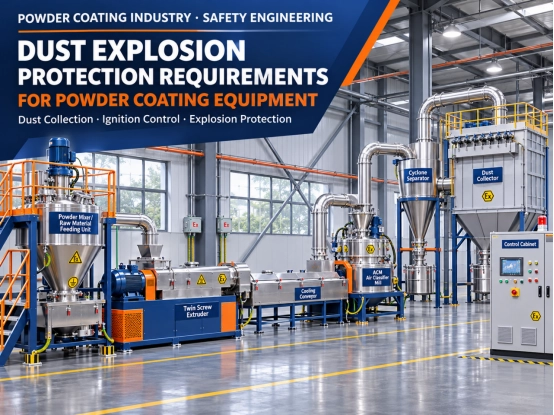
| Оборудование | Key Protection Considerations |
|---|---|
| Powder Mixer | Enclosed feeding, dust extraction, grounding |
| Двухвинтовый экструдер | Safe feeding, temperature monitoring, dust containment |
| Конвейер охлаждения | Dust control around crushing and transfer points |
| мельницы ACM | Explosion venting, suppression, isolation, suitable electrical components |
| Powder Collection System | Sealed connections, pressure protection, dust filtration |
| Automatic Production Line | Integrated safety controls and emergency shutdown |
The ACM row is the longest for a reason: the mill works the finest, most easily dispersed fraction at high speed, with rotating parts that can run hot. MPMtek’s PSR11 explosion-proof micro powder crushing system is built around this risk, with pressure-impact protection and explosion-rated components to applicable Chinese and European requirements. The boundary matters: PSR11’s rating belongs to PSR11, not to every ACM configuration or the whole line. Protection works across the line — a vent on the mill does nothing for a sieve whose duct has no isolation — so line-level thinking belongs in the production line layout.
International Standards for Dust Explosion Protection
NFPA Standards and OSHA Requirements
In North America the reference point is NFPA 660, the 2025 consolidated standard for combustible dusts and particulate solids; it frames hazard assessment, housekeeping and protection. It is a consensus standard rather than a law, but in incident reviews OSHA leans on its principles. OSHA 29 CFR 1910.107(l) covers flammable solids — the closest federal hook for powder coating operations — pushing ventilation and ignition source control even where no formal dust hazard analysis exists.
ATEX Directives and European Safety Requirements
Two directives do different jobs in Europe. The ATEX product directive (2014/34/EU) governs the equipment itself — its classification, documentation and marking for explosive atmospheres. Workplace Directive 1999/92/EC takes the plant side, with area classification, operating procedures and maintenance rules. Certified components satisfy the first; a safe line needs both.
How to Choose a Reliable Powder Coating Equipment Manufacturer
Can the manufacturer show real powder coating machinery experience, not just general process equipment? Can they produce safety documentation for the machine — assessment basis, protection type, electrical ratings? How do they handle explosion protection in milling, with reasons for the choices? Will they draw a line layout around your floor, capacity and powders, and who answers when a bearing runs hot in month fourteen? MPMtek builds the whole powder coating line, mixing through milling to complete production, and the PSR11 system is where that explosion protection is most visible.
Frequently Asked Questions About Dust Explosion Protection
Are All Powder Coating Powders Explosive?
No. Combustibility depends on resin system, pigment load, particle size and how the powder is handled. Two formulations on one line can sit on opposite sides of the hazard line — testing the actual powder, not the category, comes first.
Is ATEX Certification Enough to Prevent Dust Explosions?
Certified equipment is a necessary part of the answer — not the whole one. Without area classification, interlocks, a cleaning discipline and trained operators, the ignition sources and dust buildup that actually start explosions are still in the plant.
Conclusion: Prioritize Explosion Protection When Selecting Powder Coating Equipment
Assessment, ignition source control, dust collection, venting, suppression or isolation chosen on purpose — a line needs these before the first run. Protection integrated across the line, not bolted on machine by machine, separates a plant that runs safely from one that runs until it can’t. For configuration around your capacity and powders, свяжитесь с MPMtek for production line planning and technical consultation.