
A powder line rarely fails in one place — it fails at the seams. The mixer finishes early, the extruder starves, packaging idles while an operator chases the delay. The dumper cannot see three machines downstream; neither can the operator. The programmable logic controller (PLC) can. PLC control systems in powder coating production lines exist to hold the whole chain to one set of values and one rhythm.
What Is a PLC Control System in Powder Coating Manufacturing?
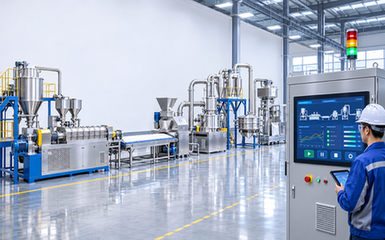
A PLC is an industrial computer built for exactly one job. It reads the machine’s signals, runs the control logic, drives the actuators back — the same cycle, for years. Take an extruder zone temperature: the sensor sends a reading, the controller compares it with the setpoint, the heater gets its instruction. Load cells at the batching hoppers, conveyor speed feedback — all of it lands in the controller, which decides which motor runs, which valve opens, at what speed. The HMI is the other half: in a PLC and HMI systems pairing the PLC executes, the HMI shows. An operator reads the temperatures, changes a setpoint, presses start. In powder coating manufacturing equipment that split matters: the logic keeps running whether or not anyone stands at the panel.
How PLC Systems Coordinate Different Stages of Powder Coating Production
A line is only as fast as its slowest handoff.
Raw Material Feeding and Mixing
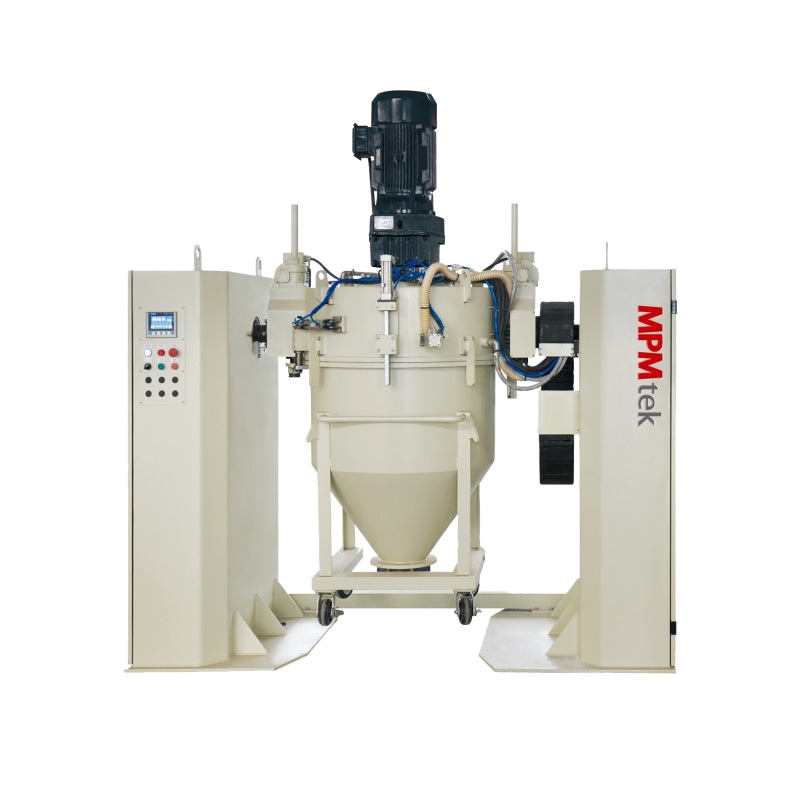
Resin goes in first, then pigments, then additives. Every batch, that order. The PLC holds the recipe: which hopper feeds first, how long the mezclador contenedor runs, at what speed. New formula, new sequence. A feeder that stalls? The program notices before the off-spec batch ships.
Extrusion and Temperature Control
Why is the extrusora de tornillo doble the tightest link? Heat, screw speed and feed rate move at once; the melt does not forgive a lagging hand. Zone controllers chase their setpoints. Screw speeds ramp in a programmed sequence. A torque or temperature excursion alarms before the extrudate sags. A stable melt in, uniform chips out.
Cooling, Crushing, and Milling
Why does belt speed matter? Chips that reach the crusher warm make more fines and heat. The PLC paces the cooling conveyor to the extruder’s output. Downstream it starts and stops the compact cooling crusher and the molino ACM in the right order.
Screening and Packaging
At the end of the line the logic looks simple: run the screen, run the bagger, keep both fed. An unthrottled packing stop propagates backwards fast — the PLC buffers the flow, so when the bagger jams the upstream stages slow and stop in sequence.
Key Functions of PLC Control Systems in Automated Production Lines
What is the controller doing all day? Four jobs, continuously.
Automated Sequence Control
One start command cascades. Dumper, mixer, extruder, cooling, crushing, screening, packing — each stage comes up in its programmed order, and at batch end the line shuts down in reverse. Nobody walks the floor pressing buttons.
Real-Time Monitoring and Alarm Management
How many signals can one operator watch? Fewer than the line produces: zone temperatures, motor currents, torque, belt speed. The program watches all of them for a full shift. One moves? The alarm names the location and points at the likely cause — not just a buzzer.
Parameter Adjustment and Batch Management
Recipes carry the setpoints: mixing speed and time, zone temperatures, screw ratios, belt speed. Select the batch and the line loads the numbers. Every run writes its own record back. A finished bag traces to the settings that made it.
Equipment Interlocking and Safety Coordination
Wrong order? Interlocks make it impossible. The extruder will not start until the conveyor is moving. The mill will not run until the crusher has stopped. The PLC enforces those rules every cycle, working alongside the machines’ independent safety devices — one is process logic, the other protection.
Major Benefits of PLC Automation in Powder Coating Production
The payoff is not headcount. The line runs the same way when watched and when nobody is.
Improved Product Consistency
What does consistent actually mean? Mixing time that is the same every batch. Zone temperatures that sit at their values. Screw speeds that change only when the recipe says so. Batch spread narrows. The lab stops chasing ghosts that were never a lab problem.
Higher Production Efficiency
Stages that used to wait on each other run as one rhythm. Changeovers lose the minutes spent walking the floor. A full shift goes through without the micro-stops — the ones that quietly add up into hours.
Reduced Downtime and Operating Costs
Same sign, two different costs. A torque spike caught in a trend: a five-minute stop. Found later in a pallet of discolored chips: a batch and a clean-out. Early alarms keep the losses small. And when maintenance argues about the cause, the recorded history settles it.
Better Production Management
Which stage is running? At what rate? Where is the line waiting? The status screens answer before someone walks the floor. A plant manager reads the floor from the office. A shift handover? A glance at the log.
PLC and HMI Integration: Building a Smarter Powder Coating Production Line
Where does the crew meet the line? The HMI. Stage status, live temperatures, batch number — the screen shows the whole chain, and a parameter change takes a tap, not a ladder. One panel can watch several machines. The same signals can feed an MES or IIoT layer: OEE per shift, energy per batch, quality trends. How far should a line go? A 500 kg/h line does not need the monitoring depth of a 1000 kg/h plant.
What to Consider When Choosing a PLC-Controlled Powder Coating Production Line
The questions below are where configurations differ.
Production Capacity and Equipment Compatibility
Start from the output you plan to sell — not the one you hope for. What must line up? The mixer’s batch size suits the extruder’s feed. Belt speed suits the crusher’s intake. The control system runs them as one line, not a set of machines with matching nameplates.
Customization and Process Requirements
What sets the demands? The formulas. Reactive resins, high-filler systems, metallics, low-cure lines — each pushes different zone temperatures and mixing sequences. Check the recipe handling: what you mix, how many formulations move in a week.
Safety and Reliability
Interlocks, protective devices, dust-explosion requirements — these belong in the control design, not added after installation. Grinding and screening areas call for their own protections. Verify what the configuration includes before the quote — not after.
Technical Support and Future Expansion
What happens in year three? Who supports the program? Can a stage be added without re-engineering? Is the configuration documented? A line bought with support that ends at commissioning is the expensive kind.
How MPMtek Supports Automated Powder Coating Production
MPMtek builds powder coating production machinery end to end — mixers, twin screw extruders, cooling conveyors, compact cooling crushers, ACM mills and the packing stages that close the loop — with PLC and HMI control configured to the line, not bolted on afterwards. The catalogue runs from lab-scale lines to full Línea de producción automática de recubrimiento en polvo configurations. Put the target capacity, the formula list and the factory layout in front of the team; the configuration matches all three.
Conclusion: PLC Automation Is the Future of Powder Coating Manufacturing
A line held to one rhythm produces batches that hold to one specification. Who coordinates the stages and guards the parameters? The control system — one process, not a sequence of machines. Choose around the production you actually run, and Contacta con MPMtek about the capacity and configuration that fit.
Preguntas frecuentes
What is the main function of a PLC in powder coating production?
It coordinates the machines on the line. It holds key parameters to their programmed values. The result: the stages run as one process.
Can PLC systems control an entire powder coating production line?
Yes. One control program runs the chain from raw material dumper to packaging — sequenced start-up, interlocks and shared logic do the coordinating.
How does PLC automation improve powder coating production efficiency?
Stages start and stop in order. Alarms surface problems early. Attention goes to exceptions, not to handoffs.