La production de revêtements en poudre dépend fortement de la constance et de la précision de son mélange. Chaque lot entrant en extrusion ou en cuisson porte la marque de la qualité de son mélange. En cas de manque d'homogénéité, même les équipements de pointe utilisés en aval ne peuvent compenser.
Pourquoi la qualité du mélange est importante dans la fabrication des revêtements en poudre
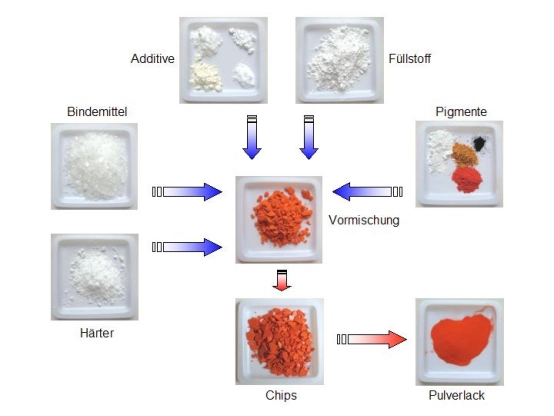
Un mélange homogène garantit l'intégrité du produit. La répartition des pigments, des résines et des additifs détermine non seulement l'uniformité de la couleur, mais aussi les performances mécaniques du revêtement final. Une légère irrégularité dans la dispersion des pigments peut engendrer des variations de teinte visibles d'un panneau à l'autre. Sur les lignes de production industrielles, cela suffit à entraîner le rejet de lots entiers.
Un mélange adéquat influe sur le comportement au durcissement et la finition de surface. La fluidité et le brillant après cuisson dépendent de l'homogénéité de la dispersion des ingrédients lors du prémélange. Un mélange insuffisant entraîne souvent des piqûres, un aspect peau d'orange ou une mauvaise adhérence entre les couches. Ces problèmes sont loin d'être négligeables : ils se traduisent directement par des retouches et un gaspillage de matériau.
Problèmes courants de mélange dans les lignes de production de poudres
Les matériaux de revêtement en poudre présentent rarement un comportement uniforme. Certains pigments sont très denses, tandis que d'autres sont légers et floconneux. La manipulation de matériaux aux caractéristiques d'écoulement différentes représente un défi, même pour les opérateurs expérimentés. La contamination croisée constitue un autre problème récurrent, notamment lors de changements fréquents de couleur.
Le passage des essais en laboratoire à la production industrielle introduit de nouvelles variables : la géométrie du mélangeur, la taille du lot et l’apport énergétique modifient tous la dynamique d’écoulement de la poudre. L’obtention de résultats reproductibles exige à la fois la précision de l’équipement et la rigueur du procédé.
Comparaison des mélangeurs à conteneur et des mélangeurs à haut rendement Mélangeurs à grande vitesse : lequel convient à votre processus ?
Le choix entre un mélangeur à cuve et un mélangeur à grande vitesse influence l'efficacité d'une usine. Chacun présente des avantages spécifiques liés au style de production et aux besoins de formulation.
Qu'est-ce qu'un mélangeur à récipient et comment fonctionne-t-il ?
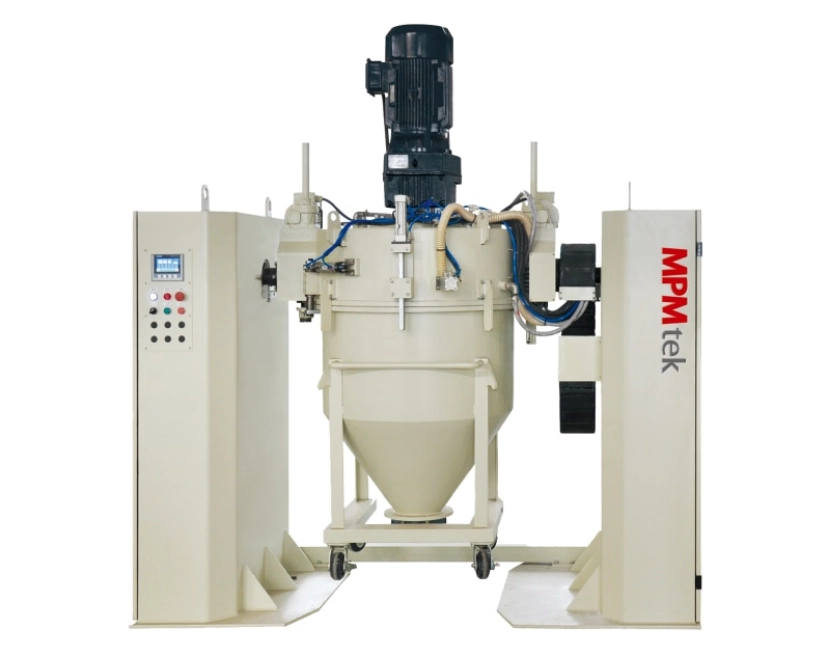
mélangeur conteneur Il s'agit d'une machine de mélange hors ligne à conteneurs mobiles, utilisée pour le mélange de matières premières. Le conteneur, chargé de matières premières, est poussé jusqu'à son poste de travail initial, puis soulevé, connecté et verrouillé automatiquement à la tête de mélange. Les matières premières sont mélangées de manière homogène par agitation et broyage à grande vitesse, tandis que la tête de mélange s'incline à 180° pour se mettre en position de travail. Une fois le mélange terminé, le conteneur retourne à sa position initiale et se sépare de la tête de mélange.
Cette conception la rend idéale pour les changements de couleur fréquents ou les productions en petites séries où la flexibilité prime sur la vitesse de production. Chaque conteneur constitue un environnement étanche indépendant, évitant ainsi un nettoyage approfondi entre les couleurs. C'est pourquoi de nombreuses usines de revêtement en poudre privilégient les mélangeurs à conteneur pour les commandes personnalisées ou les lots de recherche et développement. Lorsqu'une usine traite de petits lots de couleurs personnalisées nécessitant environ 120 litres de volume utile, un mélangeur à conteneur s'avère particulièrement adapté.
Le mélangeur à cuve est piloté automatiquement par automate programmable et interface homme-machine. Il assure un mélange efficace et homogène, et se nettoie facilement. La combinaison d'un système de basculement mécanique et d'une conception étanche minimise l'exposition à la poussière tout en respectant les normes de sécurité.
Qu'est-ce qu'un High À quoi sert le mélangeur à grande vitesse ?
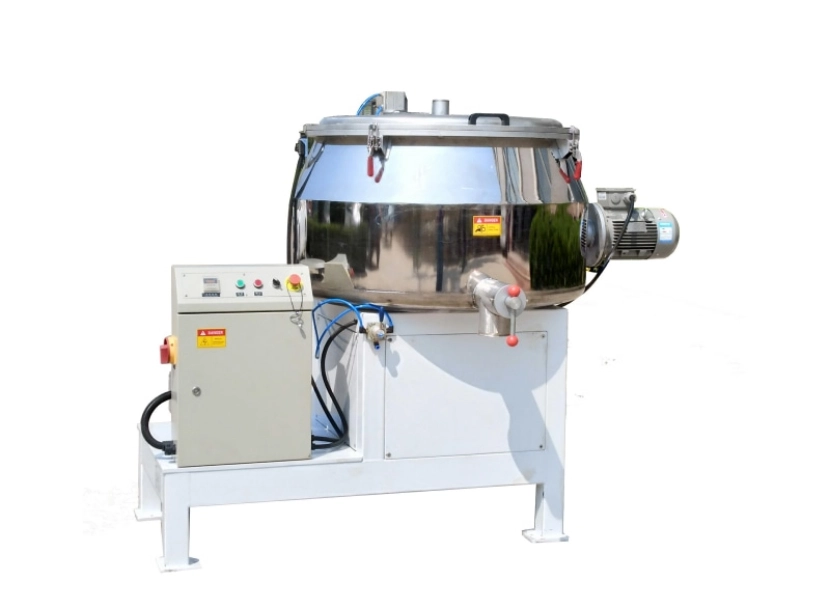
mélangeur haute vitesse Cette machine est principalement utilisée dans le mélange de revêtements en poudre époxy-polyester à électricité statique. Elle est idéale pour fournir la puissance nécessaire, agiter les matériaux agglomérés à basse vitesse et effectuer un mélange à haute vitesse. Sa fonction principale est de disperser rapidement les pigments, les additifs et les résines avant extrusion.
À l'intérieur de la chambre, des pales tournent à grande vitesse, créant une turbulence intense qui désagrège les agglomérats. Une fois les matériaux mélangés dans le mélangeur à grande vitesse, le réducteur de vitesse d'agitation est activé ; sous l'effet de l'agitation, les matériaux forment alors un anneau de tourbillons tridimensionnels. Ce mouvement garantit une interaction dynamique entre tous les composants en quelques secondes, et non en plusieurs minutes.
Les mélangeurs à grande vitesse excellent dans l'obtention d'une dispersion fine, mais présentent des inconvénients : l'usure mécanique des pales et des joints augmente la fréquence de maintenance. Néanmoins, pour les lignes de production continues à grande échelle où le temps est synonyme de rendement, leur efficacité justifie les exigences de maintenance.
Mélangeur à récipient ou mélangeur à grande vitesse : comment choisir ?
Le choix dépend de vos priorités : flexibilité ou intensité. Un mélangeur à cuve convient aux installations gérant quotidiennement plusieurs formulations ; il réduit les temps d’arrêt lors des changements de couleur et limite les risques de contamination. Un mélangeur à grande vitesse est adapté aux lignes de production à haut volume où une dispersion homogène avant extrusion est essentielle.
La consommation d'énergie entre également en ligne de compte ; les unités à grande vitesse consomment davantage d'énergie, mais réduisent considérablement les temps de cycle. Les équipes de maintenance peuvent privilégier les systèmes conteneurisés en raison de points d'accès plus faciles et du nombre réduit de pièces mobiles exposées à l'abrasion.
Facteurs clés à prendre en compte lors du choix d'un mélangeur de poudres industriel
Choisir une bétonnière ne se résume pas à la capacité ; il s’agit d’adapter la technologie au comportement des matériaux et au rythme de fonctionnement.
Adaptation du type de mélangeur à l'échelle de production et aux propriétés des matériaux
Les petits producteurs bénéficient de systèmes de conteneurs modulaires qui permettent un changement rapide de couleur ou de formulation sans interrompre complètement la production. Les grands fabricants fonctionnant en continu privilégient les systèmes à haute vitesse ou double mélangeurs à cône pour une constance du débit.
Les propriétés des matériaux sont déterminantes dans ce processus de décision. Les poudres peu fluides nécessitent une manipulation délicate ; les charges légères peuvent se séparer sous l’effet des fortes forces de cisaillement typiques des extrudeuses à grande vitesse. L’évaluation de la masse volumique apparente et de la teneur en humidité permet d’éviter les problèmes de transformation ultérieurs, tels que le colmatage ou l’alimentation irrégulière des extrudeuses.
Si le temps de nettoyage et de changement de format prime sur la vitesse pure, un mélangeur à cuve d'une capacité utile de 240 ou 360 litres sera plus facile à gérer. Pour des lots de production plus importants, de l'ordre de plusieurs centaines de kilogrammes par cuve, un mélangeur à grande vitesse d'une capacité de 200 à 800 kg par cuve constitue un choix de dimensionnement plus direct.
Évaluation de l'automatisation, des systèmes de contrôle et des dispositifs de sécurité
Les usines de poudres modernes s'appuient davantage sur la supervision numérique que sur l'intuition manuelle. Les systèmes PLC intégrés assurent la traçabilité : chaque lot est enregistré avec des paramètres identiques pour garantir la conformité aux audits. Des dispositifs de sécurité protègent les opérateurs pendant les cycles de chargement ; des systèmes d'aspiration automatisés préservent la qualité de l'air autour des postes de travail.
Le nettoyage automatisé est également important lors de changements fréquents de stores ; il réduit considérablement les temps d’arrêt par rapport aux routines de nettoyage manuel courantes il y a plusieurs décennies.
Maintenance, durabilité et après-vente Considérations relatives au soutien des ventes
La durabilité, plus que le prix d'achat, définit la valeur à long terme. Les mélangeurs fabriqués en alliages résistants à l'usure supportent mieux les pigments abrasifs pendant des années d'utilisation. Leur conception à accès facile simplifie le remplacement des lames : un petit détail qui permet de gagner des heures chaque semaine, même en cas de fonctionnement en plusieurs équipes.
Un support technique fiable minimise les interruptions de production en cas de pannes inattendues, un facteur souvent sous-estimé jusqu'à ce que les temps d'arrêt affectent durement les calendriers de production.
Comment MPMtek soutient des lignes de production de revêtements en poudre efficaces
Entre la théorie et la réalité du terrain se trouve l'ingénierie appliquée, et c'est là que l'approche de MPMtek fait toute la différence. MPMtek conçoit des mélangeurs spécifiquement adaptés au comportement des matériaux de revêtement en poudre. Chaque système est le fruit d'une compréhension approfondie acquise grâce aux retours d'expérience en usine, et non de simples hypothèses de laboratoire. Les configurations personnalisées s'adaptent parfaitement aux contraintes d'espace et aux objectifs de production propres à chaque configuration d'installation.
MPMtek L'entreprise ne traite pas tous ses clients de la même manière ; elle propose aussi bien des mélangeurs à conteneur pour les environnements de production par lots flexibles que des mélangeurs à grande vitesse destinés aux étapes de mélange rapides avant extrusion au sein de lignes intégrées. Chaque système complète les alimentateurs en amont ou les extrudeuses en aval, garantissant ainsi la continuité du processus sans goulots d'étranglement.
FAQ (questions fréquentes)
Q1 : Quel type de mélangeur offre un nettoyage plus rapide lors des changements de couleur ?
Les mélangeurs à conteneur permettent un nettoyage plus rapide, car chaque lot utilise un récipient scellé indépendant, ce qui réduit le risque de contamination entre les couleurs.
Q2 : Est-ce qu'un niveau élevé Un mélangeur à grande vitesse améliore-t-il la dispersion des pigments ?
Oui, le mouvement rapide de ses lames crée de forts courants tourbillonnaires assurant une fine distribution des pigments, essentielle avant les étapes d'extrusion.
Q3 : L’automatisation peut-elle réduire les erreurs des opérateurs ?
La commande PLC intégrée assure des paramètres constants d'un lot à l'autre, améliorant ainsi la répétabilité tout en minimisant les risques d'erreur humaine en milieu industriel.
Q4 : Quels sont les secteurs, outre celui des revêtements, qui utilisent ces mélangeurs ?
Les mélangeurs à grande vitesse trouvent des applications dans les secteurs pharmaceutique, agroalimentaire, des colorants et des matériaux de construction grâce à leur capacité de dispersion polyvalente.