
Suppose your sheet needs 90 seconds on the cooling conveyor before it will crush cleanly. With the belt running at 6 m/min, you’d need 9 m of effective cooling travel. That’s the basis of a cooling belt length calculation for powder coating: speed multiplied by cooling time, with the units matched.
I’d spend more effort checking the cooling time than debating the last decimal place in the length. If the sheet still smears at the crusher, the time you put into the calculation was too short for that run.
Measure the Cooling Window Before Choosing a Belt Length
Time the sheet from its arrival on the active cooling section. You’re following it from there to a condition suitable for crushing. Including time spent upstream in the cooling rollers would give the belt credit for work already done.
Look for clean release and usable chips. Compare the temperature with your established processing limit as well. I’d be wary of signing off a thick sheet on a surface-temperature reading alone when the heat deeper inside hasn’t yet escaped.
Give each trial record a formula reference and a measured thickness. Note how hot the sheet is when it arrives and the temperature of the water or air doing the cooling. Then keep sampling beyond startup. You’re looking for consistent cooling during the run you’ll actually have to maintain through a shift.
Convert Belt Speed and Residence Time into Active Length
With the speed reading in metres per minute, the calculation is:
Active cooling length (m) = belt speed (m/min) × cooling time (s) ÷ 60
You can also write it as L = v × t. In that version, v must be in metres per second when t is in seconds. L then comes out in metres. Forgetting the conversion gives a sixtyfold error.
Take the actual belt speed under load. A drive setting in hertz is not a travel speed. A belt-mounted reference passing fixed observation points gives you distance and elapsed time; make that observation from outside the guards.
Measure the distance where the sheet receives the cooling conditions used in your trial. Feed gaps and an uncooled discharge section cannot simply be counted toward that distance. The return run carries no product and adds no cooling residence time for the sheet.
Check Output, Sheet Width, and Thickness Against the Estimate
There’s another number worth checking before you settle on the length: how much material each square metre of belt must carry. For an even sheet moving with the belt:
q = ρ × w × h × v
For this equation, convert your hourly output q to kg/s. Enter sheet density ρ in kg/m³. Width w and thickness h are both in metres, with speed v in m/s.
The density belongs to the solid sheet. Leave loose-powder bulk density out of this calculation. Measure across the ribbon for width. If there’s bare belt along either edge, don’t count it as part of the sheet.
Don’t let a thickness average conceal a heavy strip down the middle. Slowing the belt can catch you out, too. Unless you also reduce output, you’re asking a shorter length of moving belt to carry the same incoming mass. Watch for a heavier sheet or material piling up at the inlet.
Work through a 1,000 kg/h Cooling-Belt Example
Consider a sizing exercise with these assumed operating values:
|
Input |
Valore |
|---|---|
|
Extrusion output |
1,000 kg/h |
|
Usable sheet width |
1.2 m |
|
Belt speed |
6 m/min |
|
Cooling time established in a product trial |
90 s |
|
Solid sheet density |
1,200 kg/m³ |
Putting those numbers into the length equation gives 6 × 90 ÷ 60 = 9 m.
For the loading check, the conversions are 1,000 ÷ 3,600 = 0.278 kg/s and 6 ÷ 60 = 0.1 m/s. That leaves 0.278 ÷ (1.2 × 0.1) = 2.31 kg/m² on the belt. Using our assumed density of 1,200 kg/m³ gives 1.9 mm for the sheet thickness, after rounding.
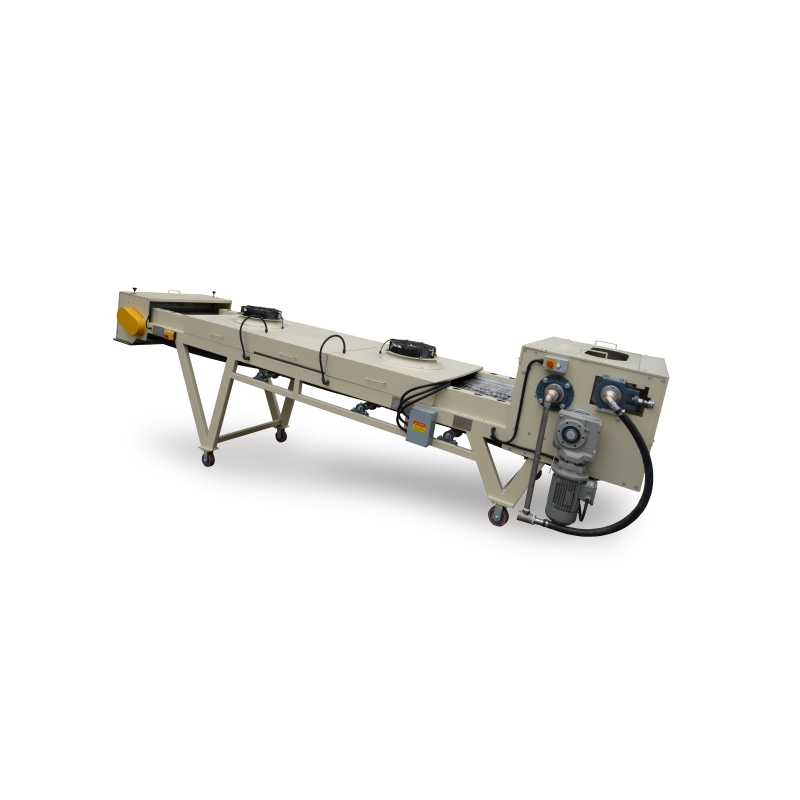
Now put an actual machine beside that estimate. With the CCB-1000 cintura di raffreddamento in acciaio inossidabile, you have a rated 1,000 kg/h and a belt measuring 8,000 mm long by 1,200 mm wide. Allow the full 8 m for cooling and our assumed speed still gets the sheet to the end in 80 seconds. We’d need to resolve the missing ten seconds in a trial or change the configuration before accepting that match.
Allow for Cooling Method, Line Layout, and Operating Variability
Check the cooling duty and the installation space separately. Both can change the machine you choose.
Cooling Duty on a Hot Day
Water-cooled steel and air-cooled slats remove heat differently. A cooling time measured on one cannot be transferred to the other. Include the warmest expected cooling-medium condition when reviewing cooling-belt selection factors. If the trial requires more time, put that measured time into the equation. An arbitrary extra metre is a guess.
Space Around the Cooling Conveyor
Put the complete machine outline on the floor plan, including its rollers and crusher. Leave somewhere to stand for cleaning. It’s also much easier to correct a transfer-height mismatch on that drawing than after the equipment arrives.
Validate Cooling Belt Length During a Production Trial
Don’t finish the trial at the end of the belt. Follow the sheet into crushing, with these observations recorded:
Weigh material collected over a timed interval at steady production.
Measure thickness across the sheet, including the centre.
Record belt speed and the available active cooling distance.
Check exit temperature and chip behavior at sustained output.
Record cooling-medium temperature alongside the fan or water-flow setting.
Take a look in the receiving container as well. Chips should still be separate there; if they’ve stuck together since leaving the belt, the trial isn’t finished.
For another run, pick a recipe you expect to be harder to cool. If you alter speed, leave cooling flow alone while checking the result. Changing both would leave you wondering which adjustment helped. Pass the trial notes to the next shift along with the calculation.
Prepare a Sizing Check for the Complete Line
Have a target output but no reliable cooling-time measurement yet? Send us your line layout and product details so we can discuss the cooling stage around the space you have.
Include the formula family and intended sheet thickness. Add the available cooling-water or air conditions. For an existing line, a note such as “sticking starts after we increase output” is useful when accompanied by the measured belt speed and output. It gives us something concrete to investigate before discussing another metre of conveyor.
Domande frequenti
Does Active Cooling Length Include the Return Run?
No. Your sheet leaves before the belt returns underneath the machine. A replacement-belt order needs the loop dimensions; this calculation needs the distance over which the product actually receives cooling.
Can I Choose a Cooling Belt by Rated Output Alone?
I’d use rated output to shortlist machines. Choosing between them takes the sheet width and cooling trial as well. We were still ten seconds short in the example despite matching the kg/h rating.
Does a Thicker Sheet Need a Longer Cooling Belt?
Usually you’ll need more cooling time. How much more depends on heat moving through that particular sheet and leaving its surfaces. Run the thickness you intend to produce rather than applying a fixed length multiplier.
How Fast Should a Powder Coating Cooling Belt Run?
There isn’t one speed to copy. Once you know the output and sheet dimensions, you can calculate a starting speed. Try it on the available cooling length and watch how the chips break at the crusher.