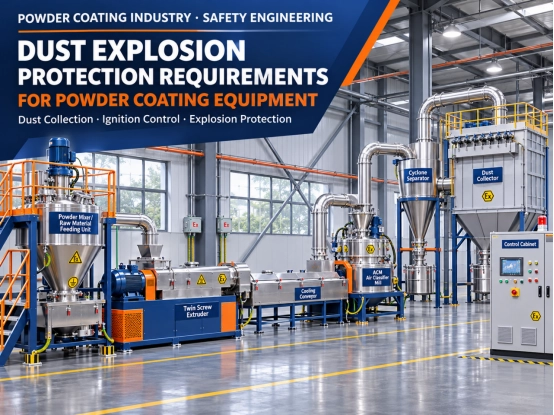
Start at the chamber wall: if the extraction stops, the classifier’s throw-off hangs in the air for hours. The rest of the plant can be ordinary equipment; the mill room cannot. When you shortlist machines, ask which side of the line each one sits on — the ATEX certificate for air classifier mills is the document that answers.
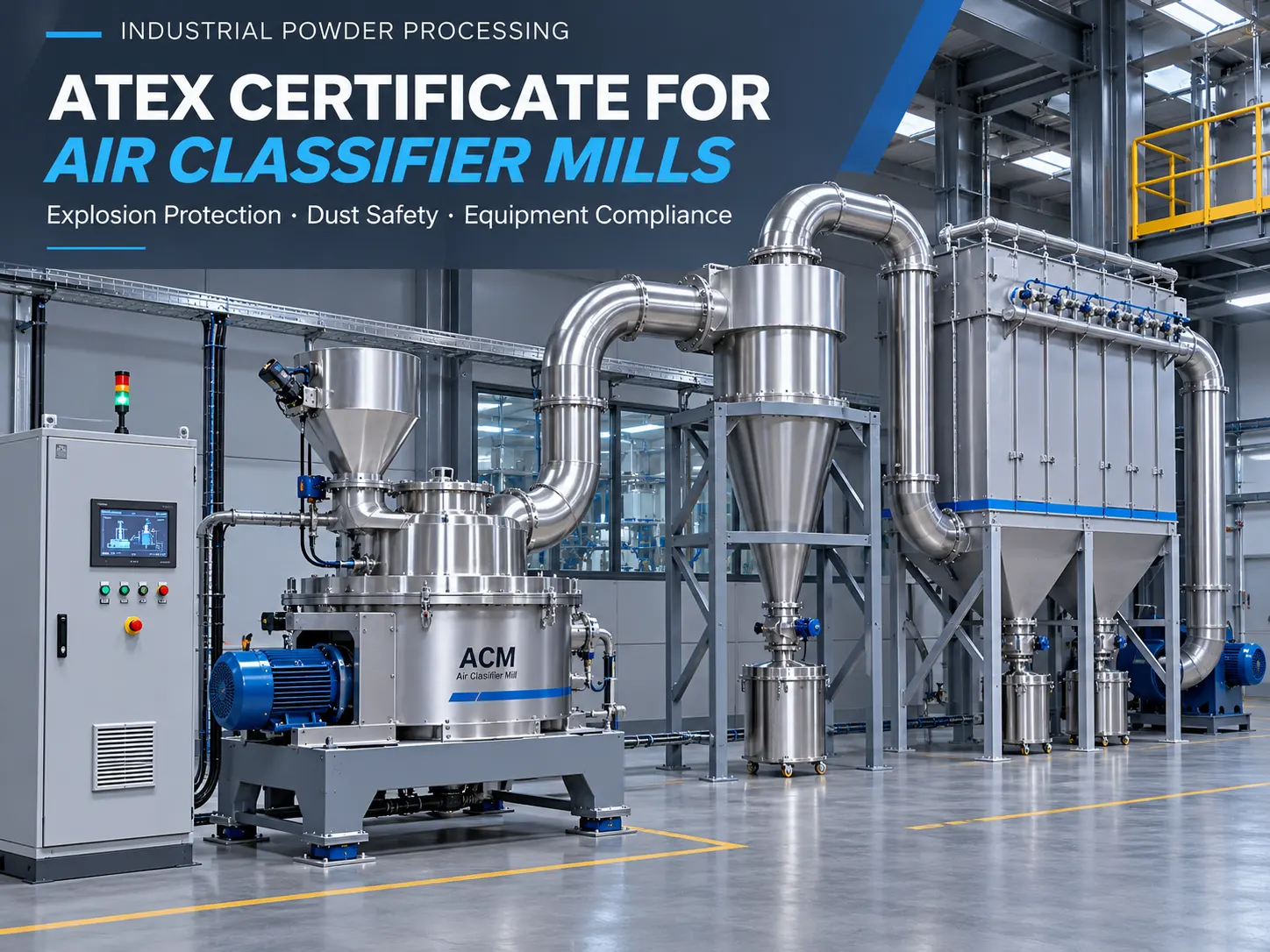
What Is ATEX Certification and Why Does It Matter?
ATEX is French — Atmosphères Explosibles, explosive atmospheres — and the framework behind it is Directive 2014/34/EU, which fixes the safety requirements for equipment and protective systems in potentially explosive atmospheres. Each product category gets a conformity assessment route; run it and a design intention becomes documented proof. That paperwork is what ATEX certified equipment actually is.
ATEX Product Directive vs. Workplace Directive
Which one is your problem? The product directive covers the manufacturer — what may be placed on the market; Directive 1999/92/EC covers the operator — the minimums for protecting workers. A compliant mill can still sit in a non-compliant plant: ducting, cleaning and area classification live on the operator’s side of the خط تولید پوشش پودر. Both documents have to line up, or projects stall.
Why Do Air Classifier Mills Need ATEX Certification?
Picture the mill mid-run: impact pins hammer the feed into the micron range, and the classifier keeps those fines airborne on purpose. Now ask what that cloud needs to go off, and the answer is unimpressive — a hot bearing, static building across a sieve, a contactor arcing in a cabinet. Any one will do. The cloud does not stop at the shell either: the air classifying mill chamber, cyclone, sieve, collector and fan all run on the same dispersion, and your combustible data sheet — ignition temperature, ignition energy, St class — sets the limits.
What Does an ATEX Certificate for an Air Classifier Mill Cover?
1. Equipment Groups and Categories
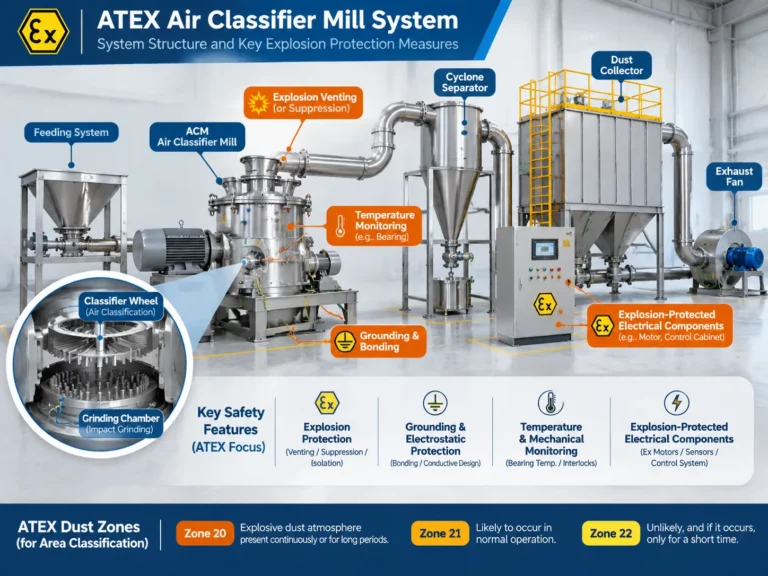
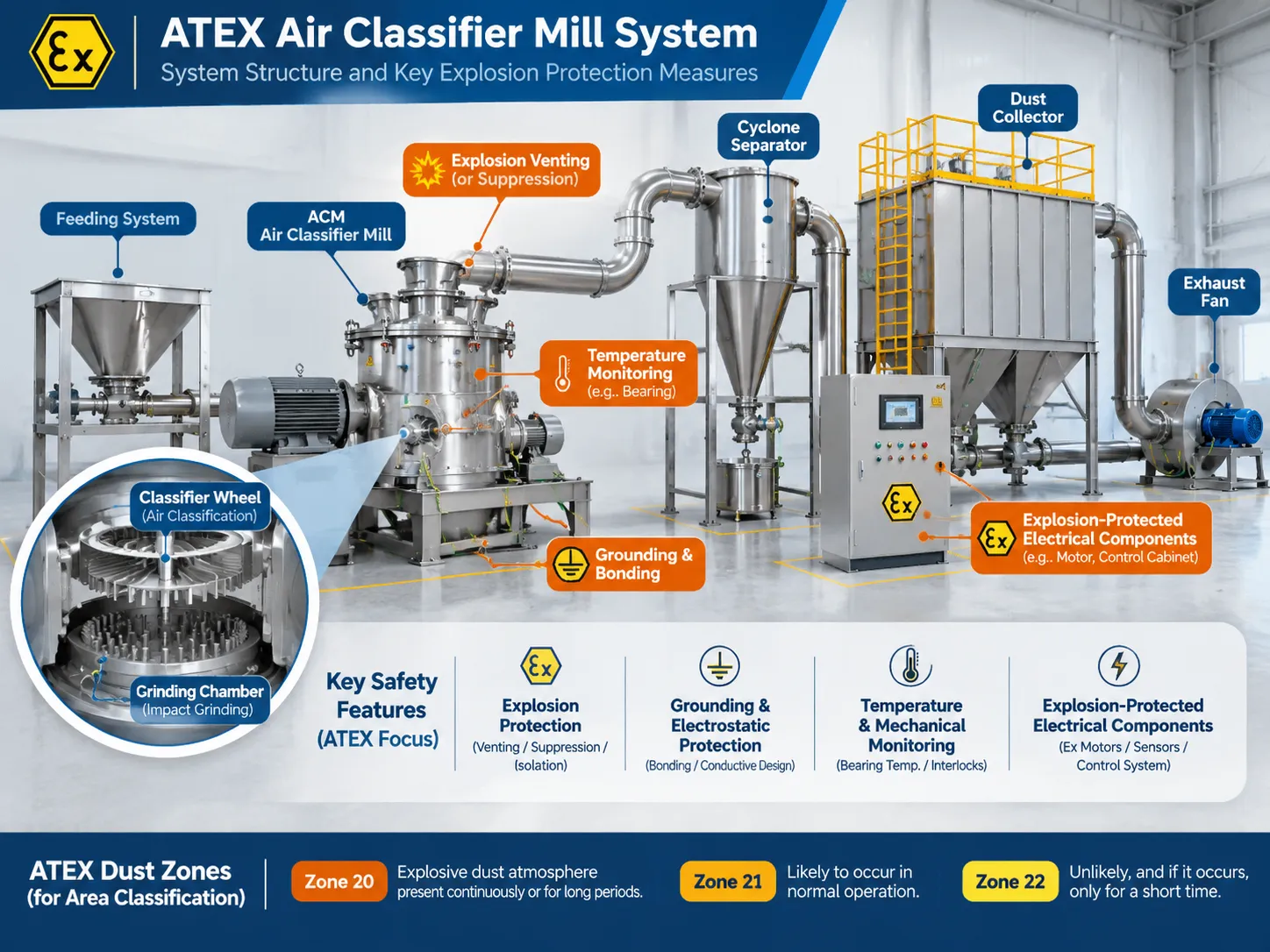
Group I is mining, where gas is the expected hazard; your mill, on the surface, sits in Group II, where dust equipment is sold as ATEX equipment categories 1D, 2D or 3D. Which number do you need? The ATEX dust zones answer it: Zone 20, where the cloud is present continuously or for long periods; Zone 21, where it can appear in normal operation; Zone 22, a brief and unlikely visit. Start from the room’s classification, not the machine.
2. Dust Explosion Protection and Temperature Limits
Can the machine ignite the mixture it is full of? That comparison drives the ATEX temperature class — maximum surface temperature checked against the ignition temperature of the dust it will actually process. Enclosures keep dust out of live parts and joints — and since a deflagration does not need a spark, wear points, bearings and screens earn the same scrutiny as the terminals.
3. ATEX Marking and Equipment Identification
Stand at the nameplate and find the group and category, the dust atmosphere marking, the type of protection and the maximum surface temperature, plus the equipment protection level where applicable. Two mills from different factories rarely carry identical ATEX marking — verify the plate against its technical documentation, not the sales deck.
Key Safety Features of an ATEX-Compliant Air Classifier Mill
1. Explosion-Protected Electrical Components
Check each component where it stands — the mill motor may sit inside the classified envelope, the HMI outside. A sensor bolted to the chamber door does not inherit the mill’s rating by proximity.
2. Grounding and Electrostatic Protection
Powder in motion builds charge: feed, convey, cyclone fall, sieve. Bond until no point holds a potential against its neighbor, with conductive elements where the flow justifies them. The one failure no bench test catches: a broken bonding jump.
3. Temperature and Mechanical Safety Monitoring
Bearing temperature is the earliest sign of friction trouble. A rising-reading alarm opens a window before a hot surface reaches the dust’s ignition limit; interlocks then shut the mill down on over-temperature or blockage. One catch: alarms stay reliable only while the chamber stays clear — the checks for preventing powder buildup inside an ACM mill belong in the same window.
4. Explosion Venting and Pressure Protection
A deflagration the first layer let through needs a second one: venting, suppression and isolation stop it walking through ductwork into connected vessels. Some mills survive the pressure shock of an internal event — the ACM PSR series’ PSR11 explosion-resistant micro-powder grinding system is one, referencing the applicable GB and EN standards. Keep the records straight: pressure-shock resistance is a structural property, ATEX certification an assessment outcome — a shock-resistant mill can still be certified for a different zone, so check both.
How to Verify an ATEX Certificate Before Buying an Air Classifier Mill
Five checks clear a supplier’s claim before the order goes out:
EU Declaration of Conformity — the one naming this equipment, directive and standards; a parent-company generic does not count.
ATEX Certificate — scope, model, intended use; the trap is the near-identical model, so confirm the quoted configuration matches.
Equipment Marking — nameplate against declaration; group, category and protection must match.
Notified Body Information — where a third party is required, verify the body and its scope; most questionable certificates die here.
Technical Documentation — installation, operating and maintenance instructions covering the dust-protection provisions.
One warning: a document stamped “ATEX certificate” is not automatically a legally recognized conformity assessment; voluntary certificates from bodies without that mandate cannot stand in for it, and the European Commission has said so. Does the paper trail support a CE marking under 2014/34/EU?
How to Choose the Right ATEX Air Classifier Mill Manufacturer
The shortlist question is not “do you have a certificate?” but “how does the equipment control ignition in the process we will run?” Weigh the answers: experience building air classifier mills, a grasp of combustible dust hazards, documentation for the exact configuration, the ability to adapt capacity and particle targets, and installation guidance with after-sales support. MPMtek specializes in powder coating production machinery and ACM micro-grinding systems, with product development focused on safety, automation, efficiency and environmental protection.
MPMtek’s Experience in ATEX and Explosion-Resistant ACM Mill Design
The ACM micro-grinding system builds around the high-speed air classifying mill, cyclone separator, fine powder collection system and integrated control system — the same chain the protection analysis covers. The PSR11 explosion-resistant design concentrates on pressure-shock protection of the grinding circuit — read it alongside the ATEX assessment, not as a substitute. Put your model, dust characteristics, hazardous area and process in front of MPMtek’s engineering team; confirm the protection measures.
Frequently Asked Questions About ATEX Air Classifier Mills
Is ATEX Certification Mandatory for All Air Classifier Mills?
Not automatically — it depends on the equipment’s intended use in potentially explosive atmospheres and the legislation applying to it. Two identical-looking machines can carry different ATEX categories: one for a plant with no classified dust area, the other for Zones 20, 21 or 22. So ask for the intended-use statement before you assume which one you are buying.
Can an ATEX-Certified Air Classifier Mill Handle All Types of Powder?
No. Certification covers ignition protection, not the material. Each powder brings its own explosion parameters and operating limits, checked against the mill’s specifications before selection. That material-by-material check is worked out in how to choose the right powder coating mill for specific materials.
Conclusion: Choose a Reliable ATEX-Compliant Air Classifier Mill
Compliant, when it matters, is a documentation question — category, protection, plate and file holding together under an audit. Choose a manufacturer with experience in dust-classified plants, then تماس با MPMtek with your powder grinding requirements to settle the ACM mill configuration the material and the zone call for.