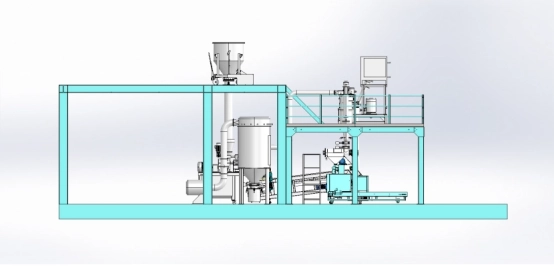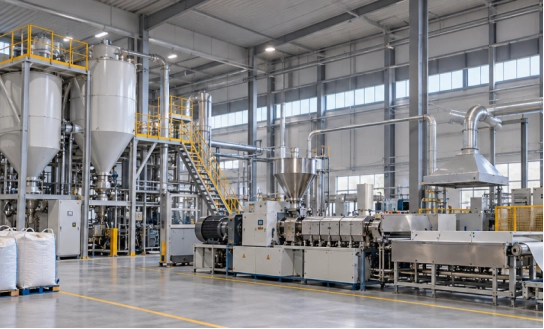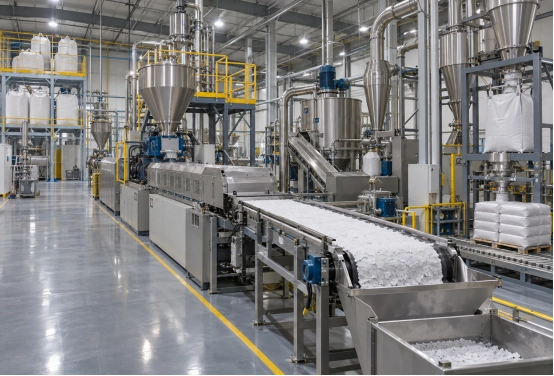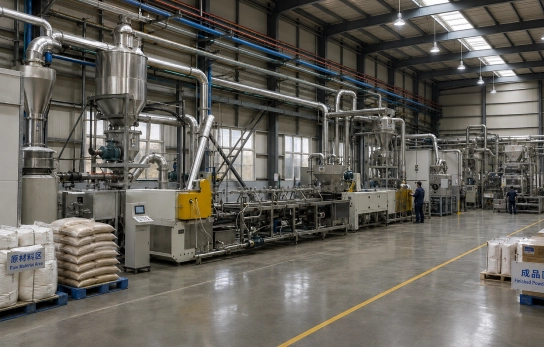
High-mix production needs equipment selected for sellable output across many short campaigns, not simply the highest nameplate kg/h. Start with four criteria: actual batch-size distribution, changeover frequency, contamination risk, and the time needed to clean and verify every product-contact area. The best configuration is the one that meets quality requirements with the least combined run, changeover, waiting, and approval time.
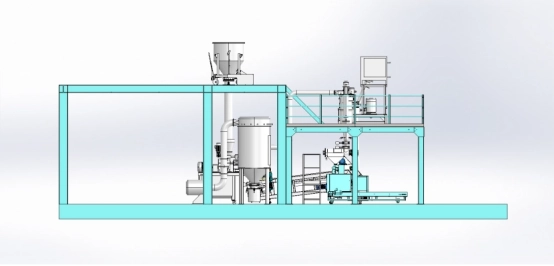
Start with Effective Output, Not Nameplate Capacity
A machine rated for high continuous output may be poorly utilized when orders are small. Each batch can require material staging, purging, cooling, dismantling, cleaning, reassembly, a transition sample, and quality release. Those activities do not appear in the rated capacity.
Define success as sellable kilograms per scheduled hour. This measure exposes whether faster machinery actually improves the weekly plan or merely reaches the next cleaning stop sooner. It also makes different line layouts comparable on the same commercial basis.
Map the Actual Product Mix
Before requesting quotations, create one row for every recurring product family. Record:
- normal and minimum batch mass;
- batches and color changes per shift;
- resin chemistry and processing-temperature range;
- light-to-dark, dark-to-light, and incompatible transitions;
- target particle-size distribution and oversize limits;
- visible-speck, color, film, and carryover acceptance criteria.
Separate a shade change from a chemistry change. Two neighboring colors may share a controlled cleaning method, while a resin or additive change may need different purging, access, and release tests. Use the real production sequence, not an average number of colors. MPMtek’s guide to a controlled color-change procedure identifies common retention points from feeding through final collection.
Compare Integrated and Modular Line Architectures
There is no universally best automation level for high-mix work. Compare the cleaning boundary created by each layout.
| Architecture | Strength | High-Mix Trade-Off | Best Fit |
| Integrated line | Coordinated transfer and fewer manual handoffs | More connected surfaces may join each changeover | Longer campaigns with repeatable recipes |
| Separate machines | Each stage can be isolated and scheduled independently | More handling and operator coordination | Small batches and frequent process changes |
| Hybrid layout | Automates stable bottlenecks while retaining selected buffers or removable containers | Requires careful controls and material identification | A mixed order book with both campaigns and custom lots |
Review the detailed automatic and separate line trade-offs before fixing the layout. A hybrid may be more useful than choosing either extreme. For example, a plant can use controlled extrusion and milling while keeping premixing offline in movable containers.
Evaluate Every Process Stage for Changeover
High-mix equipment should be judged by what can retain the previous product and how operators inspect it.
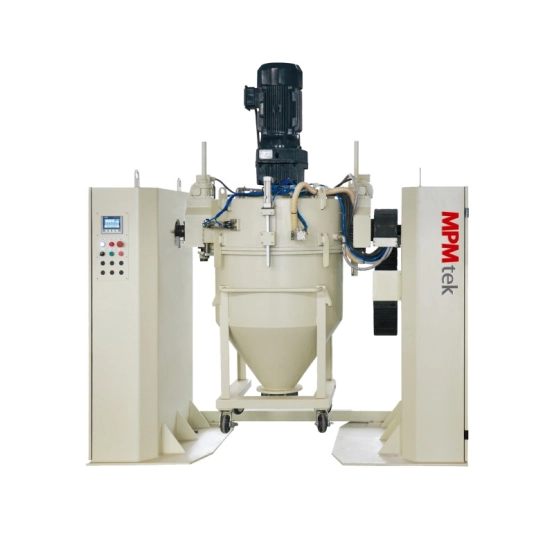
Mixing and feeding: Un movable container mixer can separate the mixing head from the container and allow another container to be prepared offline. Ask how the valve, seals, agitator, crusher, feeder screw, and docking interface are accessed. Extra containers improve scheduling only if they are identified, stored, and cleaned under a controlled procedure.
Extrusion: Compare access to the feed zone, screw shafts, barrel, outlet, and die. Request a documented purge and safe-opening method for representative formulations. A short purge is not automatically a complete changeover; the required endpoint depends on chemistry, color contrast, and the customer’s acceptance limit.
Cooling and crushing: Inspect roller edges, belt or slat joints, scraper assemblies, crusher inlets, and discharge chutes. Thin chips trapped at these points can become visible specks in a later pale batch. Accessible surfaces and enough maintenance space matter more than an attractive compact layout.
Milling and collection: Define the cleaning boundary around the ACM grinding system, cyclone, sieve, ducts, flexible connectors, filters, rotary valves, and product bins. Long pipe routes and elbows add retention and inspection points. Ask which parts open without disturbing alignment and which filters, hoses, or bins can be exchanged.
Dedicate contact parts or even a complete line only when the contamination risk and recurring workload justify it. Selective dedication for very dark, metallic, or otherwise incompatible families can be more economical than duplicating every machine.
Calculate Effective Capacity Before Sizing the Line
Use this planning equation:
Effective output (kg/h) = sellable batch mass (kg) / total elapsed time (h)
Total elapsed time includes running, changeover, waiting, sampling, and approval. As an illustrative example, a nominal 300 kg/h line needs 24 minutes to process a 120 kg batch. If changeover and release take another 36 minutes, effective output is 120 kg/h. If a different configuration reduces that non-running time to 15 minutes, effective output becomes about 185 kg/h:
120 kg / ((24 + 15) / 60) = 184.6 kg/h
This is not a performance claim. Replace every input with timed trials for the actual formulation, sequence, staffing, and acceptance method. Also model scrap or transition powder; sellable mass can be lower than batch mass.
Assess Controls, Safety, and Scale-Up
Controls should prevent recipe and container errors, not just start motors. Specify recipe permissions, batch identification, parameter records, alarm history, and confirmation that the correct container or collection bin is connected. Cleaning checklists and quality release should have named owners.
Powder hazards depend on the materials and process. Require a documented dust-risk assessment, suitable collection and protection measures, machine guarding, interlocks, lockout provisions, and evidence of compliance for the installation location. Confirm utilities and extraction loads at both normal and worst-case operation.
Before purchase, run representative formulas at laboratory or pilot scale, then confirm what changes during production scale-up. Match samples on dispersion, chip condition, particle-size distribution, recovery, and film performance rather than assuming geometric scale-up.
Domande frequenti
The following questions help test whether a proposed system fits day-to-day high-mix production rather than a single demonstration run.
Is a Fully Automatic Line Suitable for High-Mix Production?
Yes, when recipe repeatability and controlled transfers outweigh the larger connected cleaning boundary. Ask the supplier to demonstrate a difficult changeover, not only steady production of one formula.
Should Each Color Have Dedicated Equipment?
Usually not. Dedicate containers, filters, hoses, bins, or a complete line when carryover severity, change frequency, and the cost of rejection make shared cleaning uneconomic.
What Batch Size Should the Line Be Designed Around?
Use the normal order distribution and the smallest recurring commercial batch. Designing only around the largest order can create low fill, unstable feeding, or excessive transition waste on everyday jobs.
How Should Color Sequence Affect Equipment Choice?
Campaigning compatible products from light to dark can reduce routine cleaning. Equipment must still provide safe access and verification for unavoidable dark-to-light or chemistry changes.
What Should Be Tested Before Purchase?
Run representative easy and difficult products. Record output, energy and utilities, transition waste, cleaning and release time, access steps, samples, particle-size results, and film acceptance.
Prepare a Useful RFQ for a High-Mix Line
Send suppliers a product matrix, normal and minimum batch sizes, planned shifts, changes per day, color sequence, formulation families, target particle-size range, acceptance limits, available utilities, floor plan, dust-control requirements, and expansion forecast. Request a process flow, equipment boundaries, expected cleaning method, access drawing, trial protocol, and assumptions behind quoted capacity.
For a configuration review, contattare MPMTek with these inputs. A proposal based on the real order mix will be more useful than one built around a single maximum kg/h figure.