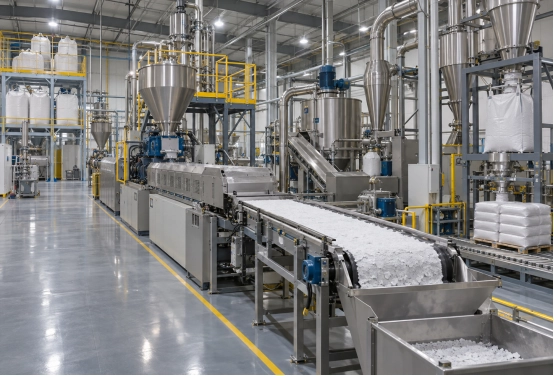
Powder loss rarely begins with one dramatic failure. A light film appears around a flange. Filter differential pressure drifts upward. A sieve rejects more material than last week. Each symptom reduces saleable yield.
The grinding section deserves attention because powder is moved and separated together. Airflow, filter condition, screen loading and sealing interact. Treating these devices as one system controls loss.
Where Does Powder Loss Occur in a Powder Coating Line?
Material can escape between charging and packing. A line walk often finds more than the report does.
Common loss points
At charging, lightweight resin or additives may be pulled toward the dust collector. Leaks develop around covers and transfer connections. Risk rises when chips enter the mill.
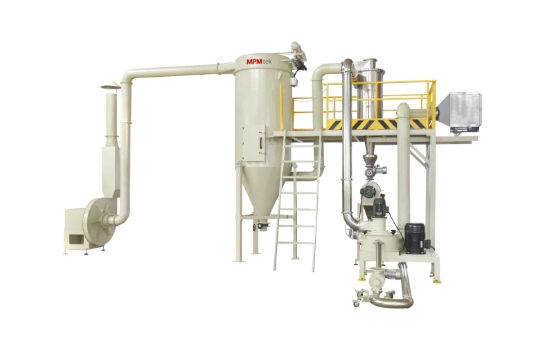
Inside an ACM system, ground powder travels through the classifier and cyclone before a rotating or vibrating sieve. Fine material may continue to the collector. Powder can remain in ducts or spill at a transfer. Packing adds loss when filling and extraction are poorly balanced.
Four forms of powder loss
Loss appears as saleable fines carried beyond collection; leakage from joints or doors; residue inside equipment; or good powder rejected during unstable sieving. Separate categories make troubleshooting faster.
A basic mass balance is enough to expose a problem:
Material input = Saleable powder + Recycled powder + Dust loss + Equipment residue
Measure by shift. Monthly totals hide short disturbances.
1. Stabilize Airflow Before Adjusting the Cyclone
Cyclone complaints often start upstream. Excess velocity carries recoverable particles into the fine collector. Too little lets powder settle in ducts. Deposits then release in slugs and upset the sieve.
Check fan speed and pressure under load. Compare readings with a clean-line baseline. Inspect connectors, doors and gaskets for air ingress. A white trace around a joint is evidence.
Mill speed, classifier speed and airflow must suit the target distribution. Raising fan speed can make yield worse. Clear restrictions before changing a validated setting. In an Sistema di micro-rettifica ACM, grinding, classification and collection operate as one circuit.
Practical tip: Do not increase fan speed simply to solve a capacity problem. Check for leakage, blockage or an incorrect pressure balance first.
2. Improve Cyclone Separation and Powder Discharge
A cyclone has no fine adjustment knob. Performance depends on inlet conditions, geometry and a sealed discharge.
Optimize cyclone operating conditions
Keep feed rate even. A mill surge increases solids loading and may push usable powder toward the filter. Inspect the inlet for buildup. Duct elbows too close to it can create an uneven velocity profile.
Cyclone size must match air volume and capacity. A unit selected only by kilograms per hour may run outside its effective velocity range. Track recovered weight with airflow.
Prevent collected powder from escaping
The lower discharge is a weak point. Worn rotary-valve tips let air travel upward through the cone and re-entrain powder. Loose clamps and collection bins cause similar trouble.
Watch the discharge during a product change. Pulsing flow can indicate bridging. Clean the buildup, then check the airlock. A sealed continuous discharge gives steadier sieve loading.
3. Reduce Powder Loss in Filter and Dust-Collection Systems
The filter is the final containment barrier, not the product receiver. A sudden increase in collected fines points back to classification, airflow or cyclone discharge.
Select and maintain the right filter media
Choose media for particle size, chemistry and temperature. Provide enough surface area. High filtration velocity raises differential pressure and can drive fines through media or seals.
Inspect bags for pinholes and damaged cuffs. Check the clean-air side for powder traces. At charging points, a raw material dumper with pulse dust collection contains airborne material. Excessive suction can capture batch ingredients.
Balance pulse cleaning
Weak cleaning builds a dust cake. Aggressive cleaning can re-entrain powder and shorten bag life. Use differential pressure to guide pulse intervals.
One plant may run well, then show rising pressure after a humid morning. The filter is not necessarily undersized. Moisture changes powder behaviour quickly. Record ambient conditions before replacing media.
4. Optimize Sieving to Protect Recoverable Powder
Sieving protects quality. It should remove oversize particles without turning good powder into waste.
Match the screen to the product
Select mesh size from the product specification and actual distribution. A finer screen may blind early, reduce capacity and hold saleable material above the mesh.
Check screen tension and edge seals during every changeover. A small tear creates off-spec product. A loose gasket allows bypass or leakage. Validate settings with the actual formulation.
Control feed and vibration
Feed the screen in a thin, steady layer. Heavy surges reduce effective area and increase rejection. Adjust vibration or rotor speed after confirming the mesh is clean.
Define a route for oversize material. Returning every reject to the mill can build contamination and distort the balance. Sample it before recovery or reprocessing.
5. Connect Cyclones, Filters and Sieves Through Better Automation
Linked controls prevent errors. The extraction fan should reach stable pressure before grinding begins. Stop mill feed if the sieve trips or high filter pressure remains active.
PLC and HMI trends make changes visible. Track fan current, filter pressure, classifier speed and sieve status. Alarm limits must trigger action. An integrated automatic powder coating line can coordinate the mixer, extruder, cooling belt and ACM section with interlocks.
6. A Practical Powder-Loss Audit Checklist
Run the audit under a normal product and record the formulation. Powders separate differently.
- Record input, finished product, recovered powder and waste for each shift.
- Check the cyclone discharge valve for air leakage.
- Review filter differential pressure and inspect bag integrity.
- Look for powder marks around ducts, flanges and flexible connections.
- Inspect the screen for damage, blinding and poor tension.
- Compare recovery and product quality before and after parameter changes.
- Link unusual results to maintenance and product-change records.
- Observe the filling point; automatic weighing and packing should control both fill weight and local dust extraction.
Domande frequenti
Q: Why is powder loss high in a cyclone separator?
Typical causes are excessive airflow, unstable inlet loading, an incorrectly sized cyclone or a leaking discharge airlock. Check the complete pressure circuit before modifying the cyclone.
Q: How can filter bags reduce powder loss?
Correct media captures fines without creating excessive resistance. Adequate filter area, sound seals and differential-pressure-based pulse cleaning keep the collector stable.
Q: Can a sieving system recover lost powder?
A sieve prevents acceptable powder from being mixed with oversize material when mesh selection and feed control are correct. It cannot recover powder already lost through leaks or carried out by the ventilation system.
Conclusione
Reducing powder loss is a system job. Air volume, cyclone discharge, filter cleaning and sieve loading affect one another. A source correction often saves more than a larger collector downstream.
For a new line or an existing recovery problem, MPMtek can develop a customized powder coating equipment and process solution around capacity, formulation, particle size and layout. Bring a recent mass balance and operating data.