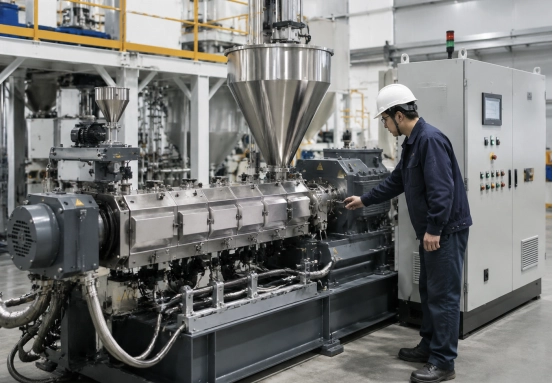
Un extrudeur de revêtement en poudre Le fonctionnement peut être fluide pendant vingt minutes, puis le couple se met à fluctuer. Des impulsions apparaissent à la sortie. L'épaisseur du ruban fondu varie. On diminue la vitesse d'avance, la machine se stabilise et on incrimine la formule.
Cette conclusion est souvent trop hâtive.
Un couple instable indique une variation de la résistance à l'intérieur du cylindre. La cause peut être l'alimentation, la qualité de la matière première, la température, le remplissage de la vis, un débit insuffisant ou l'usure. La question pertinente n'est pas simplement de savoir comment réduire le couple, mais plutôt ce qui a changé au sein du processus.
Que signifie un couple instable dans une extrudeuse de revêtement en poudre ?
Le couple reflète la résistance exercée sur les vis. De légers mouvements sont normaux lors du remplissage de la trémie ou en cas de légères variations de la matière première.
Des pics répétés, un motif en dents de scie, une lente dérive ascendante ou un mouvement proche de la limite de surcharge sont différents. Ils apparaissent souvent avec une puissance pulsée, une température de fusion variable, une mauvaise dispersion, des variations de brillance, des particules de gel ou des alarmes de surcharge.
Que devez-vous vérifier avant de régler l'extrudeuse ?
Enregistrez simultanément le couple, la vitesse d'avance réelle, la vitesse de la vis, la température du fourreau, la température de fusion, le courant du moteur et la puissance de sortie. Un graphique d'évolution concis est plus utile qu'une simple lecture sur un seul panneau.
Notez à quel moment la fluctuation commence. Après le remplissage de la trémie ? À pleine capacité ? Avec un seul pigment ou charge ?
Modifiez une variable à la fois. Ajuster simultanément l'avance, la température et la vitesse de la vis peut certes stabiliser la machine, mais cela masque également la cause du problème.
Quels problèmes d'alimentation et de matières premières provoquent des fluctuations de couple ?
L'extrudeuse ne peut traiter que ce qui atteint les vis. Lorsque la poudre arrive par à-coups, le couple varie généralement lui aussi par à-coups.
1. Surtension de l'alimentateur, pontage de la trémie ou formation de trous de rat
Une variation régulière du couple indique souvent une alimentation irrégulière. Le ruban de sortie s'épaissit puis s'amincit.
Vérifiez l'absence de pontage, de formation de cavités, d'usure des vis d'alimentation et de compactage du mélange par l'agitateur. Maintenez un niveau d'eau relativement constant dans la trémie, recalibrez l'alimentateur et utilisez un profil de vis adapté à la densité apparente de la poudre.
Pour les mélanges difficiles, MPMtek Les systèmes d'extrusion peuvent utiliser la force alimentation à double visL'objectif n'est pas une alimentation agressive, mais un débit massique constant.
2. Mauvais prémélange ou ségrégation des ingrédients
Un mélange peut paraître homogène dans le mélangeur et se séparer lors du transfert. Les charges lourdes se déposent. Les pigments fins s'accumulent dans des poches. L'extrudeuse reçoit alors des proportions résine/charge variables.
Vérifiez le temps de mélange, l'ordre de chargement, le niveau de remplissage du mélangeur, la hauteur de transfert et la manutention des conteneurs. Une chute libre importante peut compromettre un bon prémélange.
3. Modifications de l'humidité, de la taille des particules ou de la masse volumique apparente
Un nouveau lot de matières premières peut se comporter différemment même si la formule reste inchangée.
Une humidité plus élevée peut accentuer l'adhérence. Les particules plus fines peuvent se compacter. Une densité apparente plus faible réduit la masse distribuée pour un même réglage d'alimentation.
Adaptez les réglages du système d'alimentation aux conditions réelles du matériau. Un réglage universel est rarement adapté à la production réelle.
Quels paramètres de processus rendent le couple de l'extrudeuse instable ?
Lorsque l'alimentation est stable, examinez le remplissage de la vis, la fusion et le cisaillement. Ces variables sont étroitement liées.
4. La vitesse d'avance et la vitesse de la vis ne correspondent pas.
Un débit d'alimentation élevé associé à une faible vitesse de vis peut entraîner un remplissage excessif de la zone de mélange. Le couple augmente et la machine commence à osciller.
Une vitesse de vis très élevée associée à une faible avance peut également engendrer un convoyage instable. Ajustez simultanément la vitesse d'avance et la vitesse de vis. Augmentez le débit par petits paliers, puis attendez que le couple et la température de fusion se stabilisent.
5. La température du fût ou du bain de fusion fluctue
Une température basse du matériau augmente la viscosité et le couple. Une température excessive diminue la viscosité mais peut provoquer un collage, une réaction prématurée ou une décharge instable.
Si le couple moteur suit le cycle de chauffage ou de refroidissement, vérifiez les thermocouples, les résistances, les vannes de refroidissement et le débit d'eau. L'affichage peut sembler stable alors que la fonte ne l'est pas.
Une zone de refroidissement peut s'ouvrir trop brusquement. La matière fondue se rigidifie, le couple augmente brusquement, la vanne se ferme et le cycle se répète.
6. La configuration des vis crée un cisaillement inégal ou excessif
Toutes les formules de revêtement en poudre ne doivent pas être appliquées avec la même configuration de vis.
Les produits à forte teneur en charge peuvent nécessiter un transport plus robuste et un malaxage contrôlé. Les systèmes thermosensibles peuvent exiger un temps de séjour plus court. Un nombre excessif de blocs de malaxage, un angle inadapté ou un élément de retournement mal positionné peuvent créer une zone de forte concentration locale.
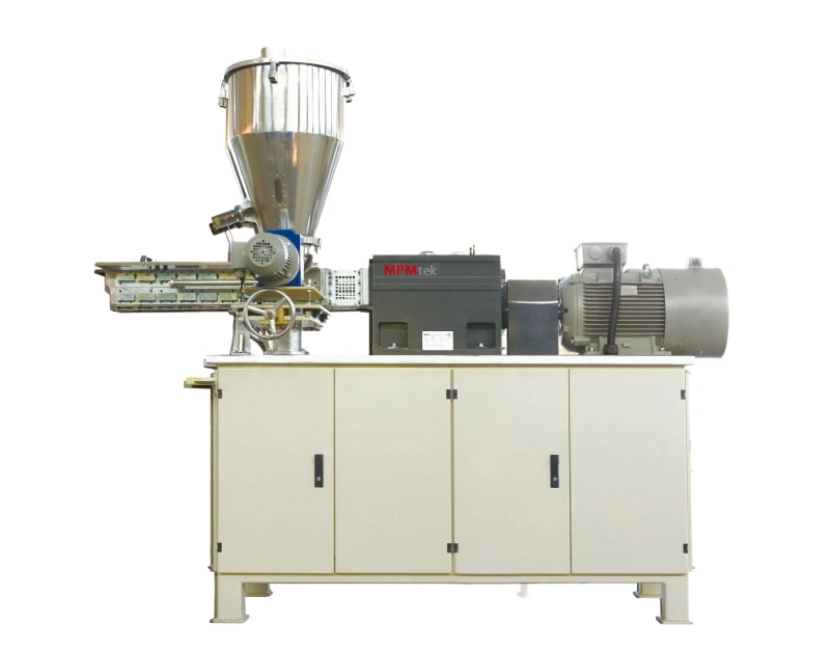
Un MPMtek modulaire extrudeuse à double vis Cela permet d'adapter la configuration à la formulation. Le gain réside dans une charge plus stable et une dispersion reproductible, et non pas simplement dans une puissance installée plus élevée.
Quelles restrictions mécaniques ou d'écoulement provoquent des pics de couple ?
Si les réglages sont corrects et que la fluctuation persiste, inspectez la machine. Les problèmes mécaniques se développent souvent lentement et sont facilement confondus avec des changements de formule.
7. Les éléments de vis, les chemises de canon ou les jeux sont usés.
L'usure modifie le transport et le mélange. Le débit diminue, les opérateurs augmentent l'alimentation pour compenser et le couple devient moins prévisible.
Vérifiez le diamètre de la vis, l'état de la chemise du cylindre, l'alignement de l'arbre et le jeu d'engrènement. Comparez ces mesures avec les rapports d'entretien antérieurs. Un simple contrôle visuel peut ne pas révéler une usure progressive.
8. L'accumulation de matière ou une décharge restreinte augmente la résistance
Des dépôts de résine durcie, de matériau gélifié ou de pigment compacté peuvent s'accumuler près du point de rejet ou dans des zones mortes.
Le comportement habituel se manifeste par une augmentation du couple et une puissance réduite ou irrégulière. Arrêtez la machine en toute sécurité et inspectez le conduit d'évacuation. N'augmentez pas la température pour tenter de déloger un bouchon ; cela pourrait entraîner la formation d'un dépôt plus dur par la suite.
9. Défauts de boîte de vitesses, de lubrification, de moteur ou de signal de couple
Toutes les pointes ne proviennent pas du matériau.
Si le couple varie alors que la puissance de sortie, le courant et l'état de fusion restent stables, vérifiez le câblage, la dérive des capteurs et l'étalonnage de l'automate programmable. Tout bruit anormal, vibration, température anormale de la boîte de vitesses ou courant moteur instable nécessite une intervention mécanique.
Vérifiez l'état de l'huile, l'alignement des accouplements, les roulements et la charge de la boîte de vitesses. Une machine présentant des fluctuations à faible charge ne doit pas être remise en production à pleine capacité.
Quelle est la séquence de dépannage étape par étape la plus rapide ?
Effectuez les contrôles présentant le moins de risques avant d'ouvrir la machine :
- Réduisez la vitesse d'avance et observez si le couple se stabilise.
- Vérifier le débit de la trémie et le débit réel du distributeur.
- Comparez le couple avec la vitesse de la vis, la température de fusion et le courant du moteur.
- Inspectez l'orifice d'évacuation pour détecter toute accumulation ou restriction.
- Rétablir les derniers paramètres de production stables.
- Modifiez une variable de processus à la fois.
- Si la fluctuation persiste à faible charge, inspectez les systèmes mécaniques et électriques.
Ne désactivez jamais la protection contre le couple pour maintenir la ligne en fonctionnement. L'alarme signale un problème de processus existant.
Comment prévenir un couple instable dans les lots futurs ?
Enregistrez le débit d'alimentation, la vitesse de la vis, les températures du fourreau, la température de fusion, le rendement et la plage de couple normale pour chaque formulation. Consignez également les variations des lots de matières premières. Une légère variation de la densité apparente peut expliquer un changement important du comportement de l'alimentateur.
Calibrer les alimentateurs et les capteurs de température. Mesurer l'usure de la vis et du cylindre avant que la qualité du produit ne se dégrade.
Les nouvelles formulations sont mieux testées à l'échelle du laboratoire. MPMtek extrudeuses de laboratoire Cela permet de définir le débit d'alimentation, la configuration des vis et les plages de température avant la mise à l'échelle. Le résultat précieux n'est pas seulement un échantillon, mais une plage de températures exploitable pour le procédé.
Conclusion : Stabilisez le processus avant d'incriminer la formule.
Un couple instable est un signal de processus, pas un diagnostic.
Surveillez l'alimentation. Contrôlez la température. Recherchez les éventuels dysfonctionnements. Comparez les données de la machine avec son historique.
Une extrudeuse stable ne nécessite pas une valeur de couple fixe. Elle requiert une relation reproductible entre le débit d'alimentation, la vitesse de la vis, la température et le débit.
FAQ (questions fréquentes)
Q : Quelle fluctuation de couple est acceptable dans une extrudeuse de revêtement en poudre ?
Il n'existe pas de pourcentage universel. La variation acceptable dépend de la formulation, de la taille de la machine, de la conception de la vis et du débit de production. Une plage de valeurs étroite et reproductible, avec un rendement stable, est plus importante qu'une valeur précise.
Q : Une température basse du canon peut-elle entraîner un couple élevé ?
Oui. Une basse température augmente la viscosité du métal en fusion et la résistance de la vis. Vérifiez la température réelle du métal en fusion ainsi que la consigne du cylindre.
Q : Pourquoi le couple augmente-t-il brusquement après le remplissage de la trémie ?
Le remplissage peut compacter la poudre, perturber l'écoulement du matériau ou augmenter temporairement le débit du doseur. Vérifiez le niveau de la trémie, le fonctionnement de l'agitateur et le calibrage du doseur.