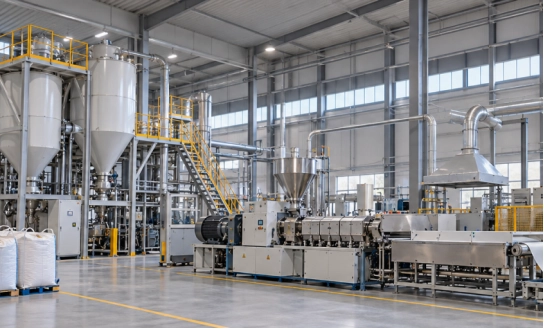
Powder coating extrudate becomes too soft or too brittle when the process moves out of its working window. It is easy to blame the conveyor because the defect is visible there. The cause may have started in the premix or barrel. Soft material smears during milling. Brittle material creates fines. Follow the material through each stage. Compare actual data with a good batch.
What Does “Too Soft” or “Too Brittle” Actually Mean?
Soft extrudate bends under light pressure. It may remain tacky on the cooling surface or resist clean breakage at the flaker. The mill then receives warm ribbons that bridge at the inlet.
Brittle extrudate breaks before the intended crushing point. The fracture looks sharp and irregular. Fine particles rise quickly after milling. Some brittleness is useful. Uncontrolled fracture points to weak cohesion, poor fusion or a steep temperature gradient.
Record outlet temperature and sheet thickness. Note solidification time and fracture pattern. Final coating performance is a separate test.
Formulation and Premixing Problems That Start the Defect
The extruder cannot correct every formulation mistake. Resin selection sets softening behavior. The curing package, wax level and filler loading matter too. Too much filler can make the flake snap.
Lubricants deserve attention. A small change can alter melt flow and ribbon release. Moisture can leave weak areas.
Premixing creates its own failure pattern. An agglomerated pigment or inaccurate additive charge may produce hard and soft spots. Compare the affected material with a retained sample. Check the raw-material lot and moisture records. A trial on laboratory powder coating equipment can show whether the formula is outside a workable window.
Why Powder Coating Extrudate Becomes Too Soft During Extrusion
Excessive thermal input is common. Barrel zones may look correct while shear raises actual melt temperature. High screw speed adds heat. A low feed rate can leave material in the barrel too long. The balance depends on the formulation.
Throughput affects cooling. A heavy feed can push a thick ribbon onto a light-duty conveyor. The ribbon remains soft downstream. A thin ribbon can have the opposite problem if the melt has been overworked.
Die conditions are easy to overlook. Uneven distribution creates a thick center or soft edges. Restricted discharge raises pressure and residence time. Sensor drift can hide a temperature rise.
Check actual melt temperature against the setpoint. Review torque and pressure. Then check feed rate and screw speed. Inspect ribbon thickness. If the defect began after maintenance, check the die and sensors before changing the recipe.
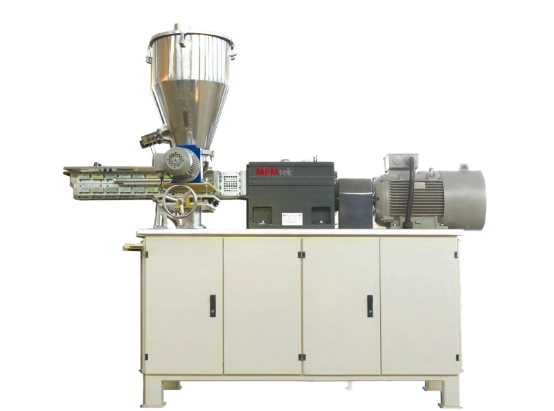
Reduce thermal load or rebalance feed and screw speed in a controlled trial. Avoid changing several zones at once. The ekstruder ulir ganda is a process tool, not a heated screw with one universal setting.
Why Powder Coating Extrudate Becomes Too Brittle During Extrusion
Brittleness can come from insufficient melting. Low barrel temperature or unsuitable screw configuration may leave resin and pigment poorly dispersed. Excessive feed can shorten melting time. The fracture follows unmelted areas instead of a uniform matrix.
Formulation imbalance is another possibility. High pigment or filler loading may reduce binder continuity. Moisture can leave voids. Thermal degradation can make a tough extrudate fragile, especially with yellowing or long residence time.
Look at the fracture surface. A chalky area or visible particle suggests poor dispersion. Torque spikes suggest unstable feeding. A sharp fracture across the entire ribbon points more toward formulation or cooling than one agglomerate.
Raising temperature may improve fusion in one formula and accelerate degradation in another. Confirm melt homogeneity and thermal history first.
How the Cooling Conveyor Changes Extrudate Hardness
The cooling stage decides whether a hot ribbon becomes a stable flake. Insufficient cooling makes material stick to the belt. A fast conveyor leaves too little residence time. Warm cooling water or weak airflow has the same effect. A thick sheet needs more capacity than its nominal line rate suggests.
Uneven cooling creates a different defect. The top may solidify while the underside remains soft. Edges may contract faster than the center. The result is edge cracking or uneven pieces. Thermal shock can make a weak formulation look like an extrusion failure.
Check belt speed and contact temperature. Measure cooling-medium temperature and airflow. Watch the full sheet width. The powder coating cooling conveyor must match extruder output and sheet thickness. It is not an isolated accessory.
A Practical Troubleshooting Workflow for Soft or Brittle Extrudate
Keep the affected lot separate. Record when the defect started and whether it follows a raw-material change, cleaning cycle or shift change. Compare good and defective samples. Check the premix before touching the machine.
Verify actual values instead of relying on HMI setpoints. Review temperature and torque with pressure. Add feed rate, screw speed and cooling to the same data set. Change one variable at a time.
Confirm the result through crushing and milling. Check particle-size distribution and application performance. A ribbon that looks acceptable can still produce excess fines in an ACM mill.
| Gejala | First checks |
| Tacky sheet | Melt temperature, cooling capacity and conveyor speed |
| Uneven hardness | Die thickness, cooling uniformity and premix consistency |
| Excessive fines | Fracture pattern, brittleness and mill settings |
| Unmelted particles | Barrel profile, screw configuration and feed stability |
How Equipment Design Helps Prevent Extrudate Quality Problems
Consistent extrudate comes from a connected process. The mixer feeds a uniform blend. The extruder delivers repeatable melting and dispersion. The conveyor removes heat at the required output. The mill needs a stable flake.
When reviewing automatic powder coating line options, ask how trials will be run and what data will be recorded. Check the cooling basis at target throughput. Maintenance access and sensor calibration matter as much as nameplate capacity.
FAQ: Powder Coating Extrudate Problems
Q: Does soft extrudate always mean the cooling conveyor is undersized?
No. High melt temperature, formulation choice and sheet thickness can make a correctly sized conveyor look inadequate. Check the thermal history before changing hardware.
Q: Can raising the extrusion temperature fix brittle extrudate?
Not necessarily. Brittle material may reflect poor dispersion or moisture. Filler loading and thermal degradation are also possible. Confirm the failure mechanism first.
Q: Why does extrudate hardness vary across one batch?
Uneven feeding or premixing can create variation. So can die distribution and cooling. A cross-width sample usually shows whether the problem is local or batch-wide.
Q: What information should be sent to an equipment supplier?
Provide the formula family and target throughput. Add the particle-size requirement and current settings. Include defect samples or photographs. Site utilities and available floor space are useful too.
Conclusion: Turn a Defect into a Process Improvement Plan
Soft or brittle extrudate is a process signal. Trace it from formulation and premixing through extrusion and cooling before replacing a component. Share the formula type and capacity target with contact MPMtek. Include particle-size and site information for a review of the complete production-line configuration.