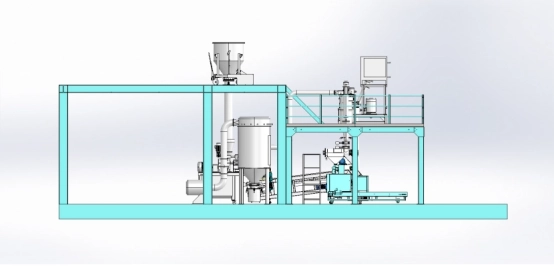
In a powder coating plant, the extruder is the stage where a formula becomes a product. The batch arrives as a dry pre-blend and leaves as a uniform melt, and what happens in between largely determines how the powder will grind, sieve, flow and spray later on. Extrusion does three jobs at once — melting the resin, dispersing pigments and additives, and pushing the melt through the die at a controlled viscosity — so when any of them drifts, downstream defects follow: streaked colors, uncontrolled particle size, poor flowability. The mill cannot fix poor dispersion, and sieving cannot restore gloss lost in the barrel.

1. Barrel Zone Temperature
Zone temperature sets melt viscosity, and melt viscosity controls almost everything else: pigment wetting, mix flow, and what the strand looks like at the die. Too low and the resin is under-melted, leaving lumps that show up as coarse particles later. Too high and additives degrade, pigments shift, and reactive systems can start crosslinking in the barrel — the classic gelled, ropey extrudate.
Practical rule: treat the zone profile, not a single number, as the parameter. Polyester systems typically run around 110–150 °C depending on grade, but always confirm against your resin supplier’s data. Keep zone-to-zone changes gradual so the melt is fully developed by the metering section. Our guide on how heating rate affects extrusion efficiency and quality goes deeper on these trade-offs.
2. Screw Speed
Screw speed sets the shear the material experiences and its time in the barrel. Raise it and you get more mixing energy — useful for hard-to-disperse pigments — but also more heat and shorter residence time, so yesterday’s zone setpoints may be too hot today. Lower it, and dispersion suffers.
Practical rule: change screw speed in small steps and let the line re-stabilize before judging the result. Never compensate a viscosity problem by quietly speeding the screws — that masks the cause and burns material.
3. Feed Rate
Feed rate sets throughput and directly changes the thermal load in the barrel: heat comes from both zone heaters and mechanical shear, so when feed rate jumps, melt temperature follows with a delay of several minutes. Fast ramp-ups are the usual cause of “cold shots” — under-melted lumps that become oversized particles in the finished powder — while a starved feeder causes pulsing flow and streaks.
Practical rule: change feed rate gradually, and divert the first material after a ramp to re-mill rather than into the product stream.
4. Back Pressure
Back pressure at the die keeps the melt packed and homogeneous as it leaves the barrel. Too low and the strand collapses unevenly, so gloss and powder density drift between batches. Excessive, and residence time stretches and the melt gets hotter — a sensitive formula can degrade even though every zone reads perfectly.
Practical rule: find the level where the strand is steady and smooth, then lock it into the recipe; a repeatable setpoint matters more than the exact number.
5. Resin Melt Viscosity
This is the parameter you select when choosing the resin, not on the control panel. A low-viscosity resin extrudes easily but offers less mixing torque; a high-viscosity one needs more heat and shear. Two formulas with identical settings can behave very differently if the resins differ.
Practical rule: whenever you change resin grade or supplier, re-validate the full parameter set. Small viscosity differences between batches of the same resin are a common hidden cause of “the same recipe giving different powder.”
6. Screw and Kneading Block Configuration
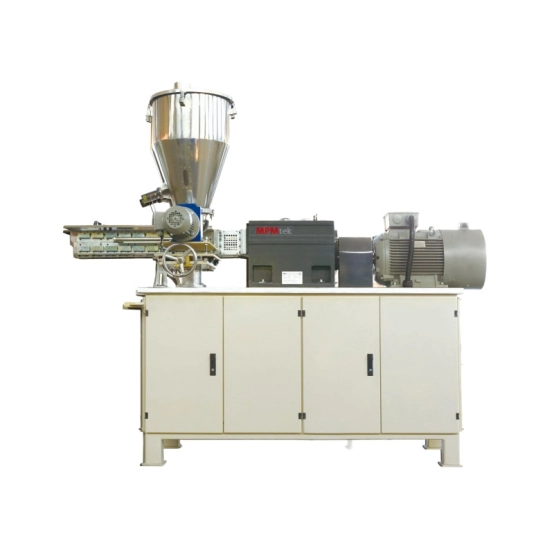
Screw geometry decides where shear happens along the barrel: feeding elements move material, kneading blocks break pigment clusters apart, and their arrangement defines the shear profile. Too aggressive a configuration destroys delicate additives; too gentle, and pigment clusters survive that no downstream step can fully undo. Modular segments on powder coating двойные винтовые экструдеры let you match the profile to each formula.
Practical rule: match the configuration to the hardest-dispersing ingredient, then verify with a dispersion check on the cooled strip — pigment mottling is the fastest visual test available.
7. Torque as an Early Warning Signal
Torque is the parameter you watch rather than set. It is the machine’s direct reading of melt resistance, reacting to changes in feed temperature, viscosity, screw wear and build-up faster than any product test. A slow upward drift often announces increased viscosity or accumulation before color or gloss shows a problem; a sudden drop can mean under-filling.
Practical rule: log torque for every batch against the last good run of the same formula, and investigate drift beyond a small normal band instead of waiting for a failed product test. Our guide on why extruder torque keeps fluctuating covers the common root causes.
How to Balance Conflicting Parameters
The seven parameters are coupled: raising temperature lowers viscosity, raising screw speed adds heat, and raising feed rate stretches the heat budget. Change one parameter at a time, in the order temperature, screw speed, feed rate — the first two set the conditions the third depends on. After each change, wait for torque and strand to stabilize, then record the full set in the recipe so a good batch can be recalled exactly rather than remembered approximately.
Часто задаваемые вопросы
Operators ask a handful of recurring questions about these settings. Here are direct answers to the most common ones.
Why Does My Extruded Powder Have Uneven Color?
Usually the fault is upstream: unstable feed rate, a zone temperature too low for complete melting, or dispersion that never reached the pigment clusters. Check the strand before grinding — if it shows mottling, fix the extrusion settings first.
How Many Heating Zones Do I Need for My Formula?
More zones give finer control over the melt profile, which matters for reactive or heat-sensitive systems; simple formulas run well with fewer. If your range includes both, a machine with flexible zone allocation is the safer investment.
What Is a Safe Way to Test a New Parameter Setting?
Run a short batch, divert the first material after stabilization to re-mill or scrap, and compare dispersion, strand appearance and torque against the reference recipe. One variable at a time is the only method that identifies which change caused the effect.
Should I Run the Extruder at Maximum Output?
No. Running near the machine’s limit leaves no thermal margin: minor material or ambient temperature change pushes the melt profile out of range, and quality suffers before output does. Most lines run best with some spare capacity.
How Do I Know When Torque Readings Are Warning Me?
Compare against history, not an absolute number. A gradual climb on the same formula points to increased viscosity or build-up; a sudden drop points to under-filling. Log every batch and review the trend after raw material changes.
Get Support for Your Extrusion Setup
If you are setting up a new line or troubleshooting an existing one, свяжитесь с MPMtek tell us your formula family and target capacity — resin system, throughput in kg/h and the product specs you need to hold. We will recommend the right configuration, from a single экструдер порошкового покрытия to a complete production line.